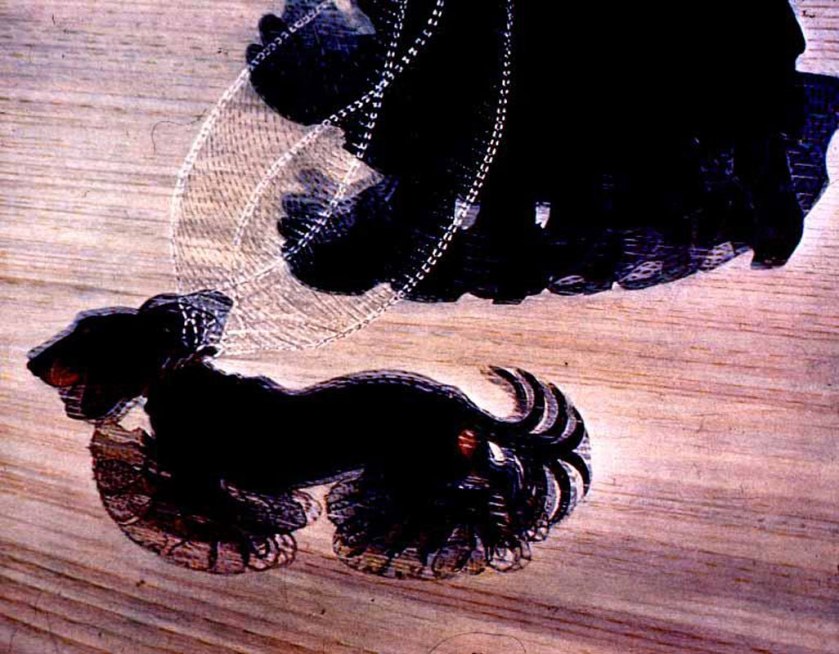
Giacomo Balla: Dynamism of a Dog 1912

Giacomo Balla: Dynamism of a Dog 1912

Balla, trained as a musician, was a self-taught artist. His early work derived from the Impressionists, especially Seurat’s Pointillism. Around 1909 he started painting in a new style, with concerns to depict motion and speed in the new Futurist style, and in 1912 he joined the Futurists. As a teacher he taught Boccioni and Severini – both to become notable Futurist artists. Dynamism of a Dog, along with Duchamp’s Nude Descending a Staircase of the same year, stand out as radical developments of the leading avant garde Cubist movement, and both clearly show the influence of Etiene-Jules Marey’s chrono-photography of the 1870s
Why does this inspire?
Because it was the first example of applied chrono-photography that I came across – researching the picture as a student, I then discovered Marey and Muybridge, Aaron Scharf’s brilliant Art and Photography (1968), and got seriously interested in technology and art.. The close relationship between the medium and the message, explained for me in McLuhan’s early books The Gutenberg Galaxy and Understanding Media, became a lifelong passion.
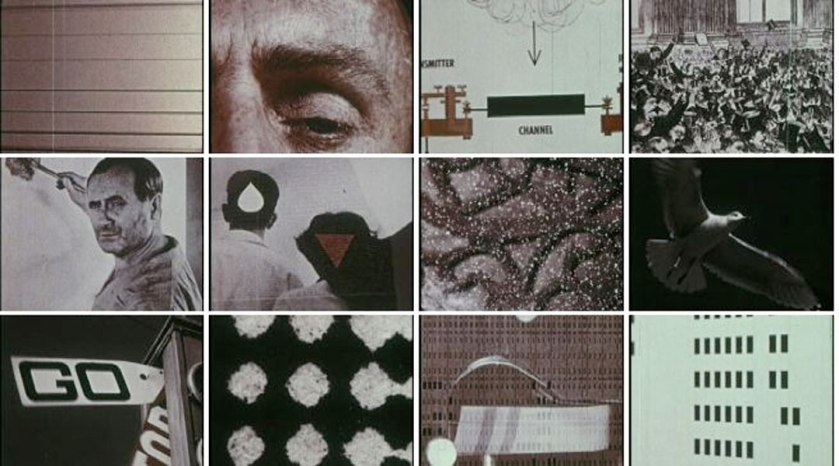
Ray and Charles Eames: A Communications Primer 1953

Ray and Charles Eames: A Communications Primer 1953

This is a seminal film. It is the work of a leading International design team, and it is the first attempt to create a primer or introduction to modern communication theory (ie it is based on the work of Claud Shannon – A Mathematical Theory of Communication, 1948) – it is a multimedia work by two designers at the height of their ideas, and ready to hone their skills using film, graphics, typography and voice-over monologue. An inspirational film that still looks ‘contemporary’ today. The Eames (Charles’ wife Ray was the film-maker) use a variety of media and a range of perspectives to introduce Shannon’s basic theory – the idea of signal and noise in the transmission of any signal from its source to its recipient – clearly to a general public, and without using any complex mathematics. They make Shannon’s then rather obscure theory relevant to everyday communications – only 5 years after Shannon and Weiner (Cybernetics – Control and Communication in Man and Machine, 1948) had established the theoretical and mathematical basis of modern telecommunications.


April Greiman: biographical poster from Design Quarterly 1987

April Greiman: biographical poster from Design Quarterly 1987

Three years after the invention of the Apple Macintosh – one of the key technologies bridging the analogue and digital design epochs -the leading graphic designer April Greiman puts the Mac and its software tools through their paces. In 1984, the Mac was sold with bundled software produced by Apple, including MacPaint (a bitmap editor), MacDraw (a vector-based graphics program), and MacWrite – a cool word-processor. Combining this suite of software to produce a life-size (6-feet long) fold-in poster for an issue of Design Quarterly, Greiman pulls together her fascination with contemporary iconography and reprographic processes and uses a scan of her own body, and her idealised ‘spiritual double’ complete with montaged annotations – all this on a Mac with a one-bit (black or white) screen of 512×342 pixels (about 7 inches by 5 inches), a printer that only printed US Letter size (8.5×11 inches), and a scanner not much bigger than the standard paper size. Greiman, trained under leading Swiss School German designer Wolfgang Weingart, was the first graphic designer to illustrate the potential of digital. Despite the low-resolution, miniature screen size, monochrome limitations, Greiman celebrates these qualities while transcending their limitations, creating an icon of the transition to digital.

This poster was featured in a series of double-page spreads in Greiman’s monograph Hybrid Imagery – The Fusion of Technology and Graphic Design (1990) – in itself a seminal influence on graphic design, and an inspiration for designers, typographers and intermedia artists.

Godfrey Reggio: Koyaanisqatsi – Life Out of Balance 1983

Godfrey Reggio: Koyaanisqatsi - Life Out of Balance 1983

Reggio assembles a documentary-style chronological montage reflecting the impact of industrialisation and population-growth on our planet. It’s like looking at the Earth through the elapsed time vision of an alien watcher, at once beautiful and shocking, like looking into an ant colony as it goes about its business. Philip Glass has produced the mesmeric, iterative score. Ron Fricke is the cinematographer. (ten years later, Fricke went on to produce Baraka (1992). Reggio uses elapsed time, stop motion, slow motion, and other techniques to tell this story. It has a script comprising just one word. It is at once a prayer, a mantra, a meditation and a plea. It is a cool and stylish appraisal of where we are at. It reminded me of the ethos of the Whole Earth Catalog – ‘We are as Gods. We might as well get good at it.’. And it reminded me of Buckminster Fuller’s An Operating Manual for Spaceship Earth.

Commenting on the almost script-less approach to Koyaanisqatsi, Reggio said:

“it’s not for lack of love of the language that these films have no words. It’s because, from my point of view, our language is in a state of vast humiliation. It no longer describes the world in which we live”


Richard Dawkins: Biomorphs 1986

Richard Dawkins: Biomorphs 1986

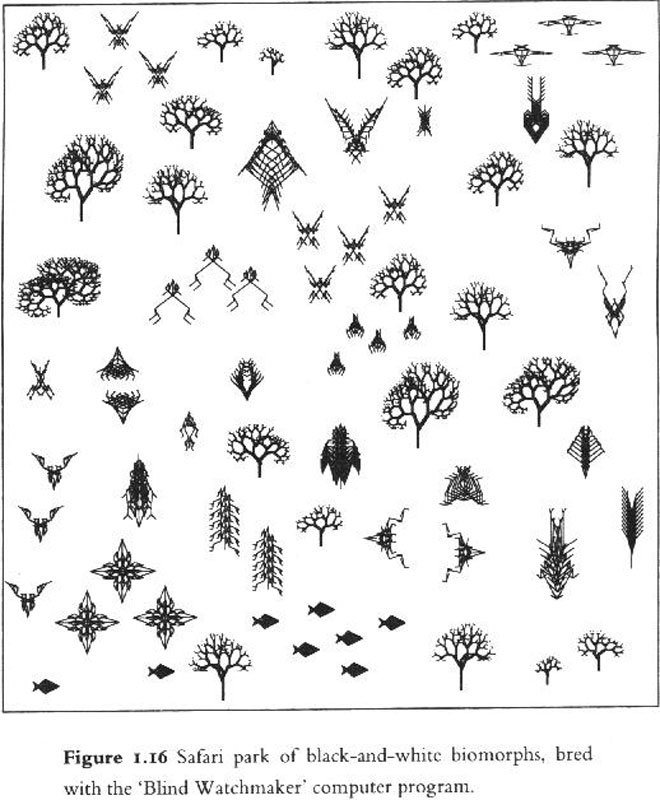
In his 1986 book The Blind Watchmaker, Dawkins described Biomorphs – a simple software program he had written to illustrate the power of Darwinian evolution. His program, written on an Apple Macintosh computer, simulated the evolutionary process of a simple stick-insect-like creature that had merely 9 parameters (or ‘genes’), which could be selected for by the human user. It was an example of un-natural selection, where the selected-for traits were determined by the user thinking – ‘oh that’s interesting!’, or ‘that’s pretty’. The nine gene parameters controlled branching, segmentation and symmetry, and each gene was subject to random mutation. When he ran the program – it drew another iteration of the stick-insect’s evolution every screen-refresh – Dawkins was astonished at the variety such a simple bio-simulator (this research sector became known as Artificial Life and the software a type of  genetic algorithm) could produce.

“When I wrote the program I never thought that it would evolve anything more than a variety of tree-like shapes…Nothing in my biologist’s intuition, nothing in my 20 years’ experience in programming computers, and nothing in my wildest dreams, prepared me for what actually emerged on the screen….(nor) convey my feeling of exaltation as I first watched these exquisite creatures emerging before my eyes.”
From Dawkins: The Blind Watchmaker, 1986.


The moral of this story? That just like in real life, complexity can evolve from some some very simple rules, and genetic variation follows – new ‘species’ emerge.

In his book summing the early years of Artificial Life research, Steven Levy has this to say on the Biomorphs:

“Although the (biomorphs) experiment played like a game, it followed the same rules that nature did. In evolving creatures, Dawkins noted, one was not creating them, but discovering them. They already existed, in a sense, as possible permutations of a given set of genes, and of a finite number of mutations. This was what biologists referred to as ‘genetic space’ a mathematical atlas that geographically located all possible life-forms.”

Steven Levy Artificial Life – The Quest for a New Creation 1992

unknown artist: Diableries 1861

unknown artist: Diableries 1861

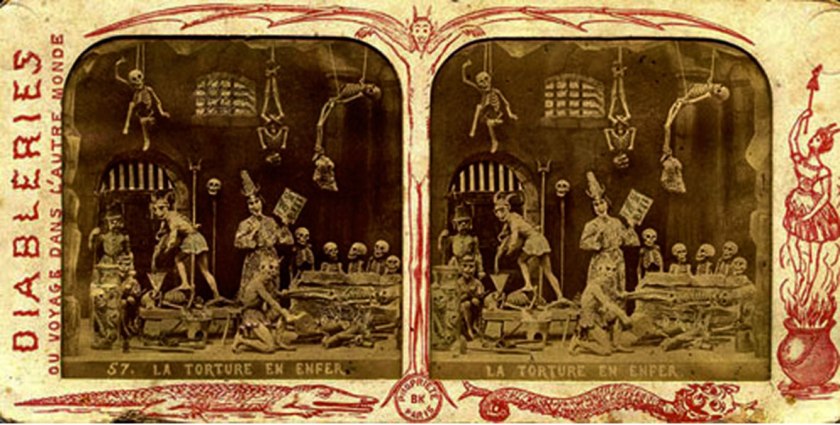
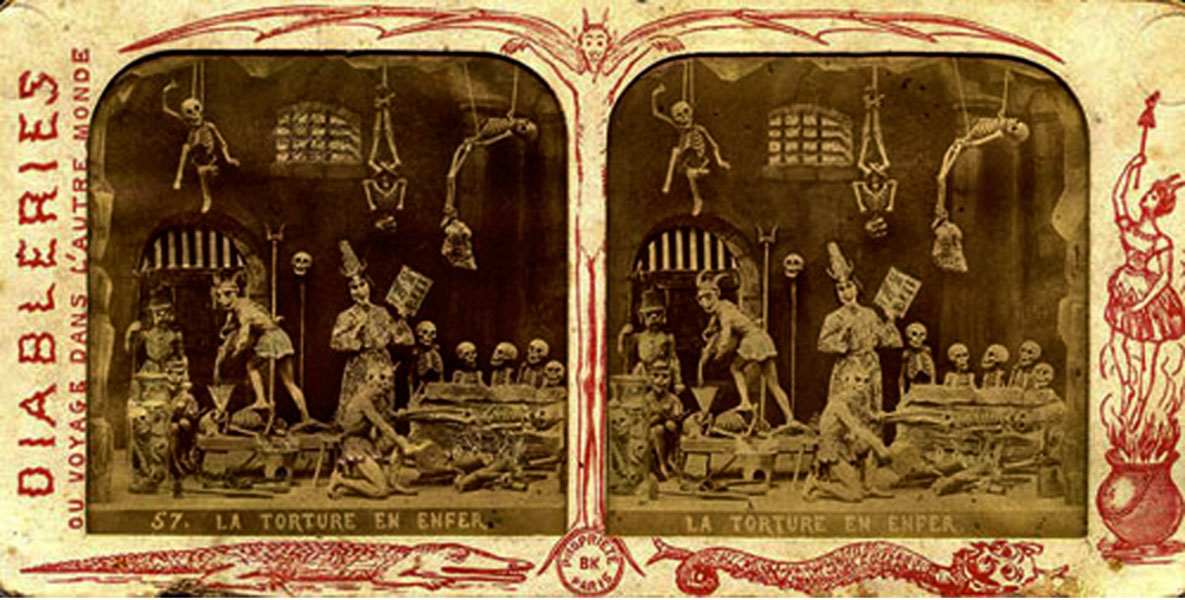
Charles Wheatstone developed his theory of stereopsis in 1838, building a stereoscope to validate his theory. Louis-Jules Duboscq invented the stereograph or stereo photograph in 1851, presenting his new work at the Great Exhibition. In 1852 Duboscq introduced his Duboscq-Soliel Stereo Viewer – a piece of drawing room furniture through which his stereographs could be viewed to obtain the maximum 3-d effect. This machine, and similar stereo viewers engendered an interesting effect – that people, once they had got used to the stereo 3d effect, wanted more images to experience. Hundreds of thousands of stereographs were produced to satisfy this new market for home entertainment, many of them mundane and most of them visually un-inspiring. However from the early 1860s, sets of stereographs began to appear anonymously in Paris and became cult collectibles. Eventually a suite of 72 cards – called Les Diableries – became available and much sought after. The Diableries were photographs of table-top dioramas – tableaux illustrating the machinations of the Devil. Because of the signatures on some of the miniature sculptures and figurines, some surmise that it was the artist Pierre Adolphe Hennetier who was the creator of these fascinating depictions of the underworld. It is interesting that Gaspard-Felix Tournachon (Nadar)’s photographs – the first taken by electric light – in the maze-like Parisian sewers and underground tunnels had been published just a year or so before the Diableries appeared. As if the re-discovery of the real underground Paris catalysed the Diableries as fanciful and macabre visualisations of the metaphysical underground. The Diableries is an extended series of three-dimensional tableaux, tapping into a vein of religious iconography stemming from works like the Danse Macabre of the Mediaeval period, and looking forward to the horror genre of the movies. This is a very accomplished set of stylistically coherent illustrations – a remarkable feat, perhaps even more remarkable for its anonymity. The musician and photo-historian Brian May has collaborated recently on a major study of the Diableries, which is highly recommended.

William Henry Fox Talbot: Photoglyphic Engraving 1858

William Henry Fox Talbot: Photoglyphic Engraving 1858

By making images directly onto a photo-sensitised zinc or copper plate, Fox Talbot demonstrates the potential of photo-engraving. The principle was simple. A gelatine and bichromate mixture was coated onto a metal plate, then it is exposed to light through a photo-positive or actual object. Where the light reaches the plate, the gelatine-dichromate mix is hardened, while the image areas can be washed away, thus forming a mask for the etching fluid (acid). When the acid has ‘bitten’ to a suitable depth, the plate is washed, cleaned, then rolled-up with ink. The smooth non-images areas of the plate are wiped free of ink, which remains in the etched image areas, and is then printed in an etching press. The thick blankets of the etching press push the paper into the ink-filled image areas and the print is made. Fox Talbot added a kind of aquatint dusting of gum copal over the image, to create texture for the acid to bite into, and he marvelled at the results – the finest tracery of lines and subtle gradation of tones. Fox Talbot credited the origin of photo glyphic engraving to Wedgwood, who had experimented with these techniques in 1790s. Daguerre’s collaborator, Nicephore Niepce had also experimented (the Physautotype) in the 1820s. Late Karel Klic was to fully develop this technique as the Photogravure process (1878).

Andy Warhol: Self-Portrait on Amiga Paintbox 1982

Andy Warhol: Self-Portrait on Amiga Paintbox 1982

Warhol was one of the great media-artists of the 20th century, an accomplished graphic designer and illustrator with a background in Madison Avenue in the late 1950s. Warhol became the most celebrated of all the artists exploring the imagery of popular culture, and almost surprisingly, he became simultaneously a leading figure in the American Film counter-culture. Famous for his replicated soup cans and Brillo boxes, his silk-screen prints of Marilyn, and his team of artists, art-workers, superstars, based at his studio – the Factory, Warhol experimented with several media in the Sixties (including developing his Exploding Plastic Inevitable light-show with the Velvet Underground), and he was still experimenting in the early 1980s – here with the multimedia Amiga (famed for its graphics, video and 3d modelling capabilities. Warhol is experimenting with Amiga’s early bitmap-editor or paintbox software on a prototype Amiga (it was finally launched in 1984 – the same year as Apple’s Macintosh (using the same chipset – the Motorola 68000). He quickly grabs the essence of the Paintbox – grabbing a video image of himself and manipulating textures and colours.

Munich Centre for Clinical Neuroscience: Eye-See-Cam gaze-driven camera 2008

Munich Centre for Clinical Neuroscience: Eye-See-Cam gaze-driven camera 2008

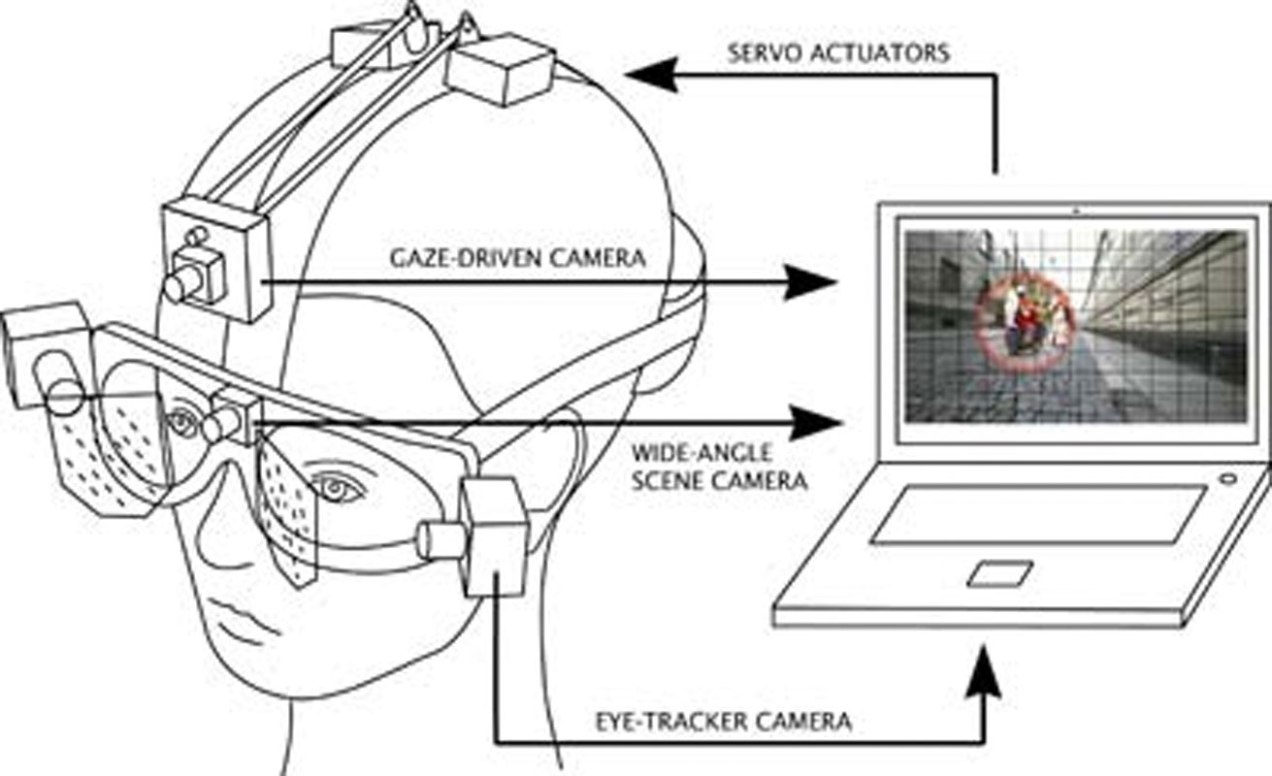
Great. In the 1960s the psychologist Alfred Yarbus investigated the way we actually see, proving once and for all that the eye is not a camera, contrary to the popular perceptual model, and that on the contrary, our vision is saccadic – we scan our field of view, with points of interest being examined in an attention-driven pattern, dependent on what task the viewer is performing. This is at last a kind of proof that the Cubists (Picasso, Braque, et al) were right – their paintings actually represent how we see the outside world.


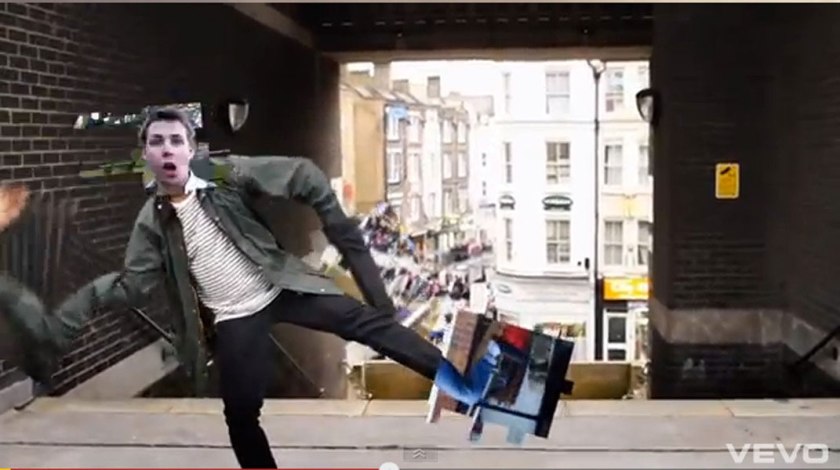
Ninian Doff + Graham Coxon: What’ll It Take to Make You People Dance? (From A+E) 2012

Ninian Doff + Graham Coxon: What'll It Take to Make You People Dance? (From A+E) 2012

For me, this was one of the first crowd-sourced music videos to really work. Coxon and Doff posted their music track on the web, calling for video-clips of steps to be sent in, and offering signed albums and tour tickets as an incentive. The submitted video-clips were assembled and composited by Doff and Coxon in a montaged video-cubist style promo video, featuring clips from 85 people in over 20 countries.