Charlie Parker: Bebop Jazz 1939-1945

Charlie Parker: Bebop Jazz 1939-1945

Charlie Parker, Dizzy Gillespie, Miles Davis et al: Bebop Jazz  1939 – 1945

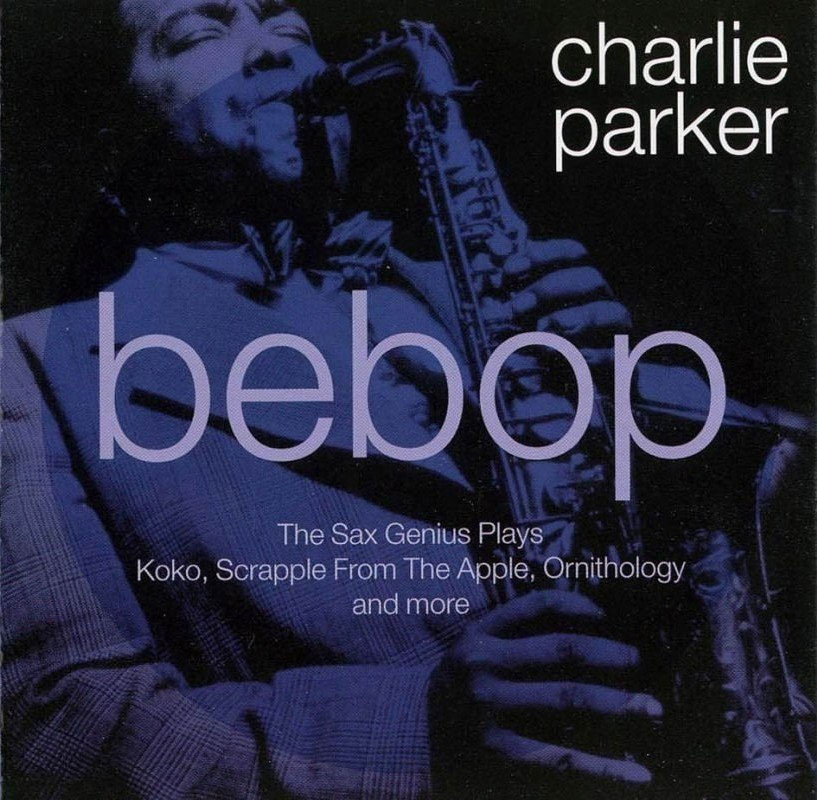
Bebop jazz was probably the first iteration of ‘modern jazz’ (though Louis Armstrong had introduced the extended improvised solo in the 1920s) – Bebop was the first non-dance jazz genre, characterised by improvisation, assymetric phrasing, solo instrumentals, scat singing, and intricate, ‘non-linear’ melodies. Bebop is associated with Charlie Parker, Dizzy Gillespie, Miles Davis, Coleman Hawkins, Lester Young, Cannionball Adderley and Thelonius Monk. Later in the 1950s and 1960s, variants of Bebop like Cool Jazz, showcased by Chet Baker, Milt Jackson, Stan Getz, Dave Brubeck became very popular. The individual – the solist – takes personal control of the shape of a piece of music, themically linking it to a base tune or melody, but freely improvising around that basic theme. An inspirational model for creative innovation…. My favorite post-Bebop saxophonist is the great John Coltrane.

Bebop had its own distinctive ‘cool’ graphics  BlueNote Records with sleeves designed by Reid Miles and photographs by BlueNote co-founder Francis Wolfe, set a distinctive style in graphics, breaking new ground in display typography, hinting at Swiss School breakthroughs, effectively defining the style of jazz albums thereafter. 
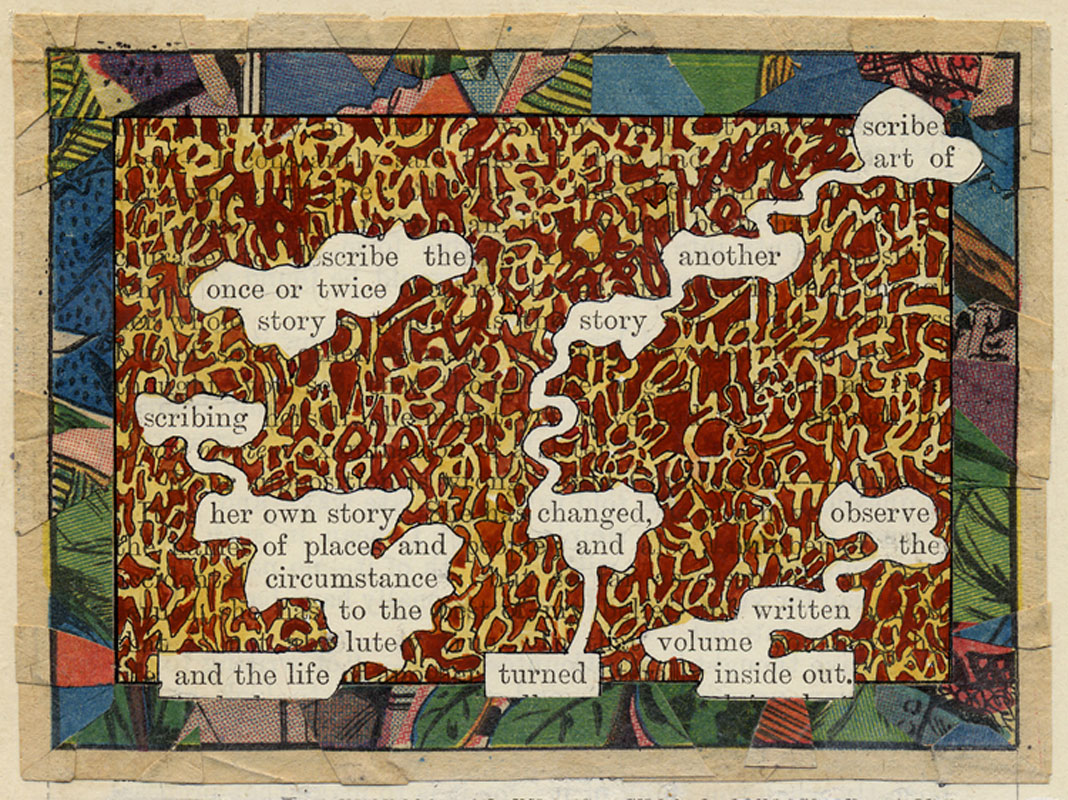
Tom Philips: A Humument 1970 (book) 2011 (app)

Tom Philips: A Humument 1970 (book) 2011 (app)

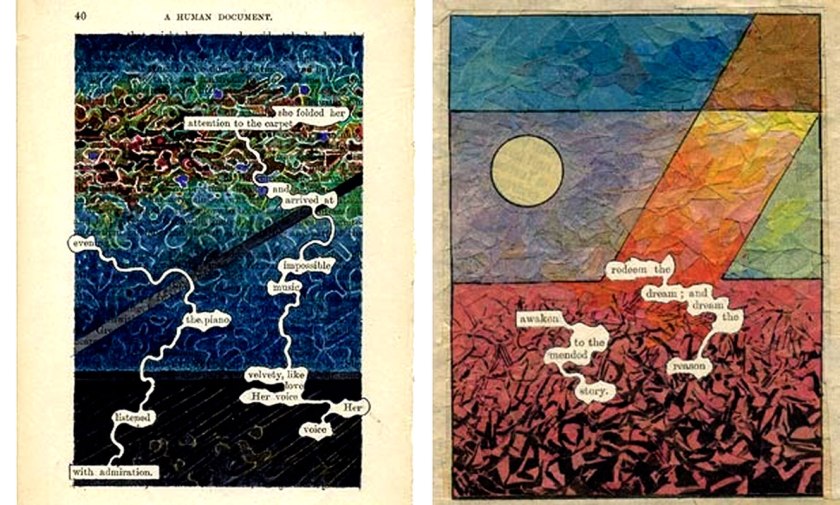
Tom Philips is one of those leading artists not bound to a personal style or signature methodology. His work is fascinating, various, eclectic and always just right. A Humument is an experiment. It involves creating new texts and readings from an existing book, in this case A Human Document by W.H. Mallock – an obscure novel that Philips bought for 3 pence in a Furniture Repository in Peckham Rye.

He writes:

“Like most projects that ended up lasting half a lifetime, this work started out as idle play at the fringe of my work and preoccupations. I had read an interview with William Burroughs (Paris Review 1965) and, as a result, had played with the “cut-up” technique, making my own variant (the column-edge poem) from current copies of the New Statesman. It seemed a good idea to push these devices into more ambitious service. “

Jacqueline de Jong: Situationist Times 1963

Jacqueline de Jong: Situationist Times 1963

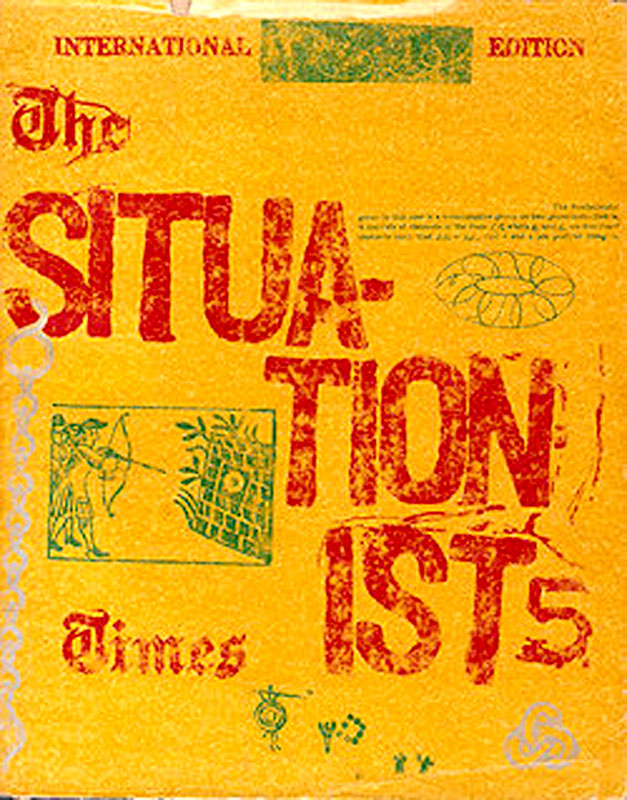
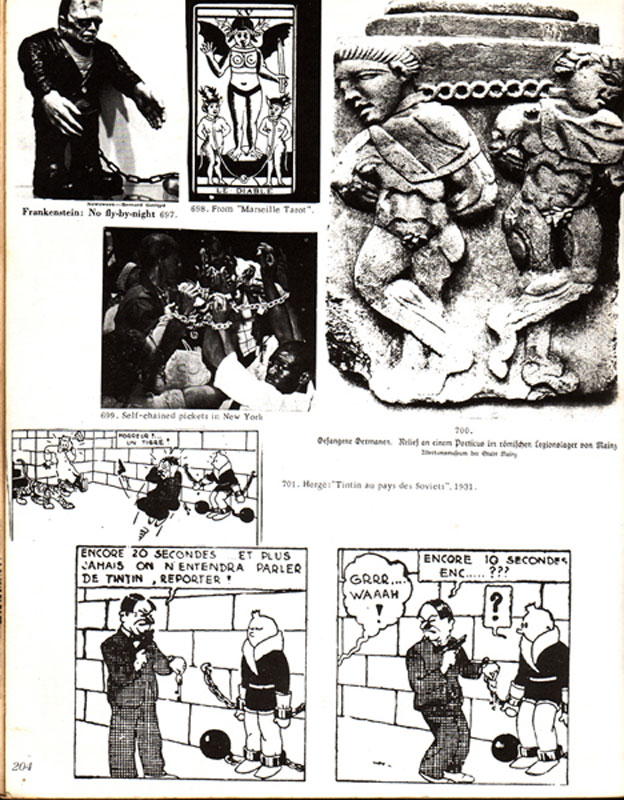
“Editors Note: In this No. of the Situationist Times (5) do we try to open up the problem of the ring, interlaced rings and consequently chains. This happens on the base of the three patterns of European culture which are introduced in Jorn’s article on ‘Meaning and Sense’….All we try to show here in an artistic way is a certain connection of the three patterns with topological aspects. It is up to the reader if he wants so, to make his own conclusions.”

This how the editor Jacqueline de Jong sums the contents of issue No 5 of the Situationist Times – a journal in letter-format (220x280mm). A total of 6 issues were published by de Jong from Paris and Copenhagen in 1600 copies per issue between May 1962 and December 1964. The article by the Danish artist Asger Jorn: Mind and Sense – on the principle of ambivalence in nordic huisdrapa and mind singing – is Jorn’s attempt to validate and evangelise the importance of Nordic Art in the face of Denmark applying to join the European Union (a process that began in 1961). After a three-page (2500-word) article, explaining the Nordic artist’s role as a shaman, the issue is a non-linear collage of images related to the theme of the “ring, interlaced rings and consequently chains”, with essays on the mathematical aspects, the history, mythology and symbolism, magic circles, games with hoops and rings. It is fascinating.

US Government: SAGE (Semi-Automatic Ground Environment) 1963

US Government: SAGE (Semi-Automatic Ground Environment) 1963

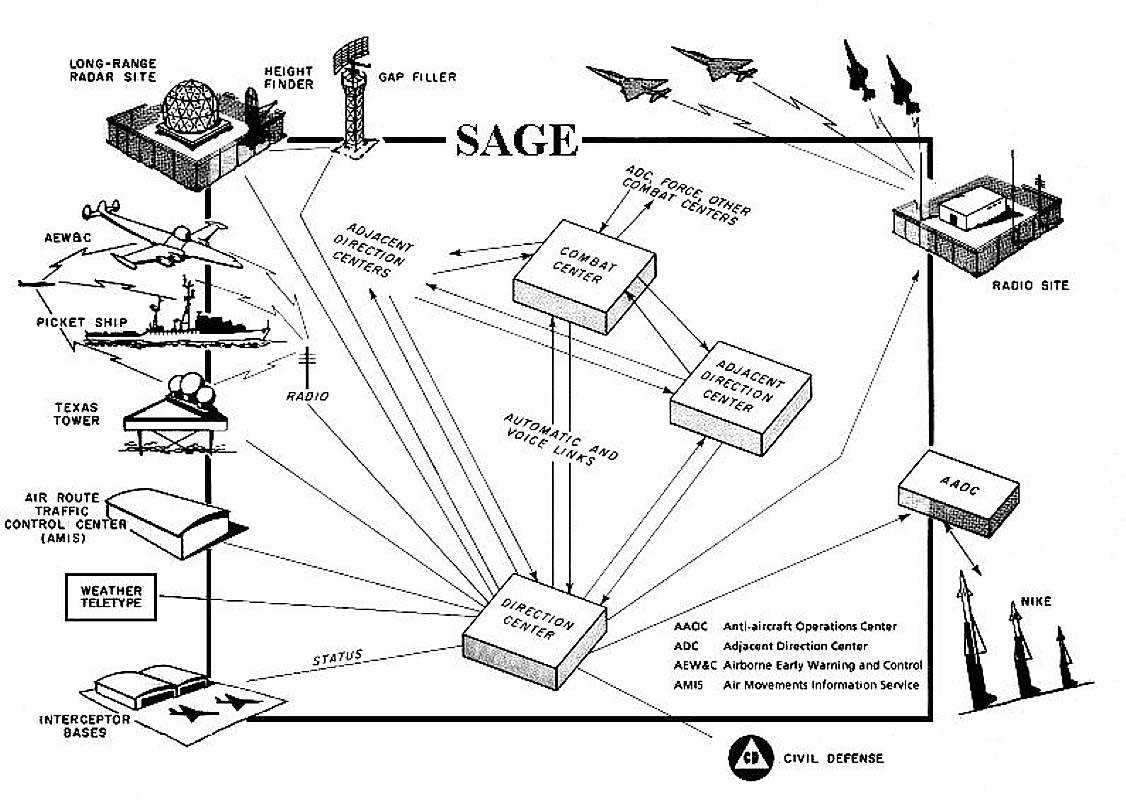
1963 saw the culmination of a decade-long program to build an air-defense system to protect the North American continent against attack by bombers. SAGE was the first integrated national computer-telecoms system. It was designed to expedite communications between early-warning (DEWLINE) long-distance RADAR, air-observation units, strategic command head-quarters, and the fighter, anti-aircraft and missile defence resources around the USA and Alaska.

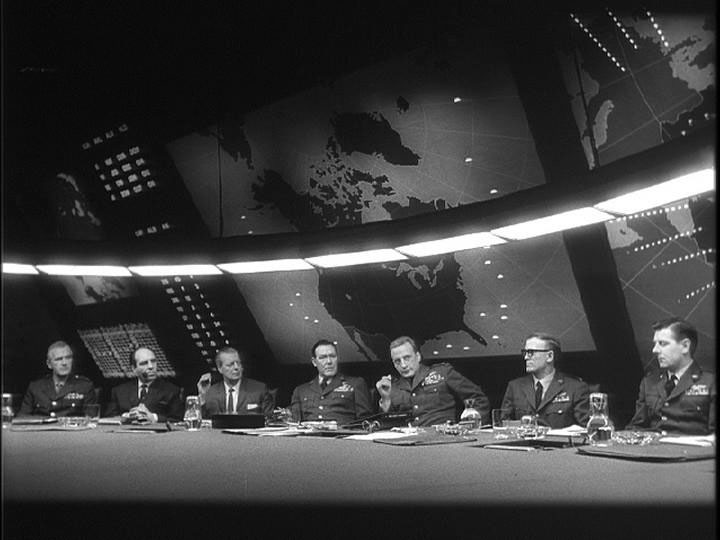
This elaborate, computer-controlled national network formed a major part of the MAD nuclear strategy (Mutually-Assured Destruction – the idea that any nuclear offensive would be met by an automatic nuclear retaliation.) These systems and this strategic policy were mercilessly and hilariously satirised in the Stanley Kubrick’s 1963 movie Dr Strangelove (Or How I Learned to Stop Worrying and Love the Bomb), and more seriously, and less successfully,  perhaps in Sidney Lumet’s Fail Safe (1964). However these integrated systems informed similar systems like the UK National Air-Traffic Control (1962), and arguably, the ARPANET-Internet (1969-77).

Ken Adam designed the Pentagon War Room set for Dr Strangelove – an amazing and prescient vision of how large projectors and computer-data visualisation might look in the near future. It looked so realistic that apparently the Russians were seriously worried by the apparent IT gap! And 30 years later, when Reagan got to be President, he was most disappointed that the War-Room looked nothing like Ken Adam’s vision.

Michael Moorcock (ed): New Worlds SF 1967

Michael Moorcock (ed): New Worlds SF 1967

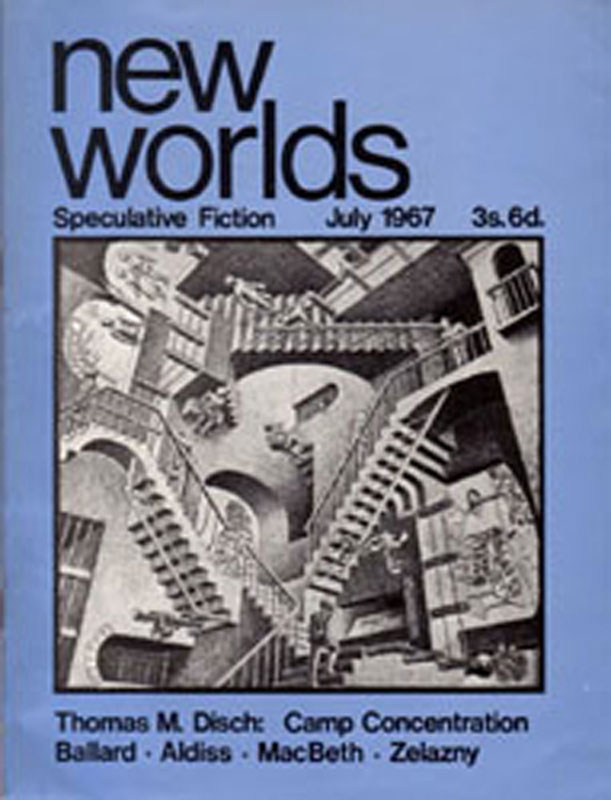
Moorcock took over the editorship of New Worlds in 1964, and a few years later, he was managing a magazine that had seized the zeitgeist head-on. In this August 1967 issue, the cover features the work of Eduardo Paolozzi – the Scottish Italian sculptor and ‘co-inventor’- of Pop Art (with his contemporary Richard Hamilton). This was one of a tiny bundle of magazines that in one way illustrated and in another way formulated, the spirit of the age. These included Architectural Design (AD), Oz magazine, International Times (IT), Rolling Stone (in its original low-print-cost, newsprint-paper, offset litho form), and of course New Worlds SF. New Worlds received a small annual grant from the UK Arts Council in recognition of the fact that Moorcock was featuring the best speculative fiction, articles about modern art, philosophy, science. It was a monthly fix of what was happening in the late 1960s – in poetry, fiction, SF, art, thought.

Vannevar Bush: Memex 1945

Vannevar Bush: Memex 1945

Bush was chief science advisor to President Rooseveldt in WW2, and as such he had to examine thousands of proposals, inventions, papers, reports, and condense all these for the US cabinet. At the time Bush only had filing cabinets and card-index systems to help him sort and archive these documents. He dreamed of a filing system that would echo the way we actually think – the sequence of associative ideas that we create in our minds.

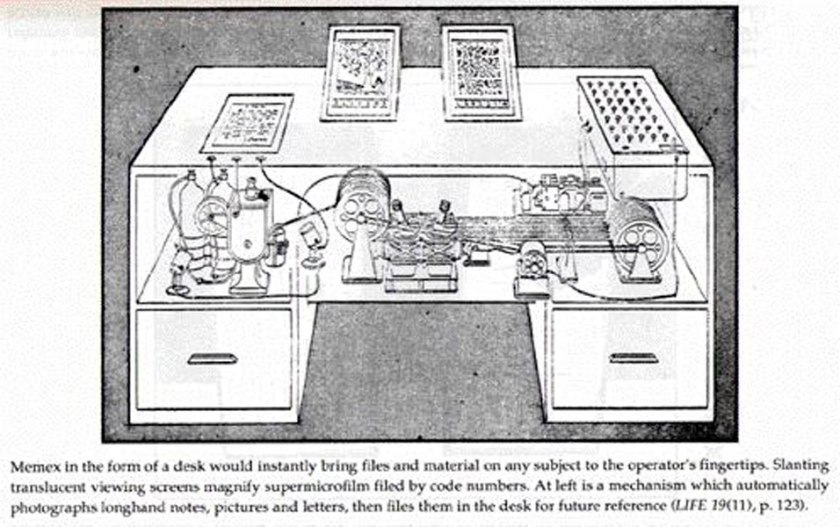
Immediately after the war, he himself wrote a paper, published in the influential Atlantic Monthly, entitled As We May Think. In this article he described an experimental memory-extension machine he had devised, called the Memex. Memex could store records (files), our notations,  and ‘associations’ – the conceptual links with other documents that made them a valid expression and communication. This machine could scan documents, make copies of them on microfilm, archive them with an index number, and retrieve them on demand, either by browsing through the archive, by typing a keyword, or by clicking on a link from one archive document (record) to another. Not only that, but the user could add notes and links to other Memex records, and if needed, build an associative  trail‘ of links connecting several or several dozen records together. He could then send this ‘trail’ of links to other Memex owners, so that they could follow the same logic, peruse the same evidence, the same diagrams, the same pictures.

Yes – Vannevar Bush described a hypothetical hypertext machine in 1945, some twenty years before the hypertext pioneer Ted Nelson coined the actual word. Now we all have computer-based personal digital assistants – our own Memex machines, but we still can’t send his associative trails.

Richard Buckminster Fuller: Geoscope World Game 1961

Richard Buckminster Fuller: Geoscope World Game

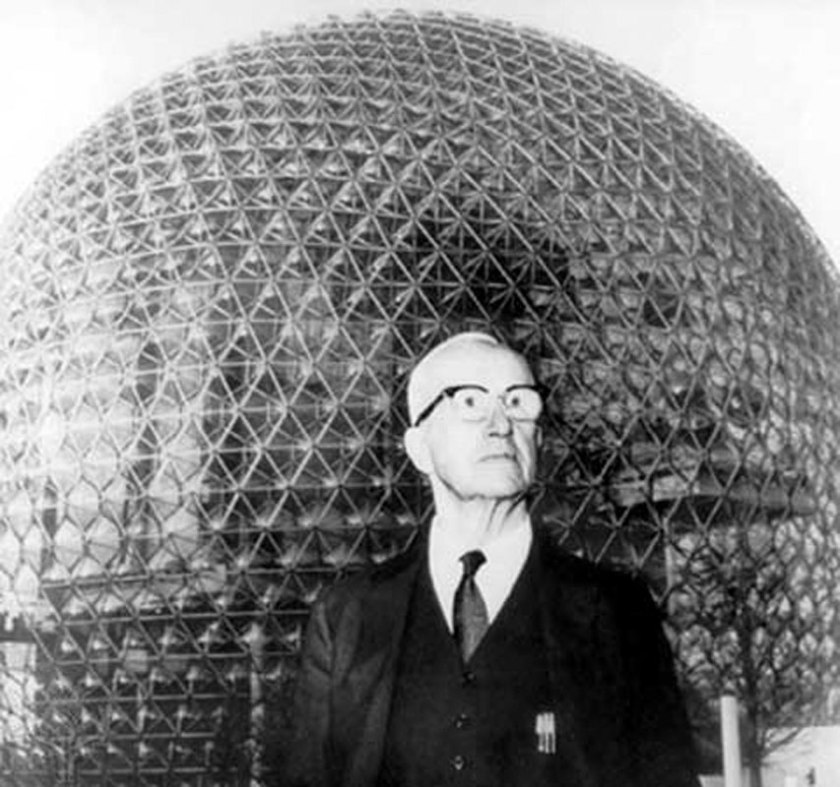
In the early 1960s, working with the English futurist John McHale and the architect Shoji Sadao, Fuller began work on his idea for a World Game with a geodesic Geoscope data-visualisation tool. The geoscope was a 200-foot sphere studded with light bulb-size ‘pixels’ that could display a variety of geo-political, geo-physical, and other data – the World’s resources, World population, pollution, de-forestation, etc. These would be the results of a World Game program – a simulation of the planet and its resources,  where design-scientists, engineers, – even politicians – could suggest policies for how to ‘“make the world work for 100% of humanity in the shortest possible time through spontaneous cooperation without ecological damage or disadvantage to anyone”. These grand ideas were reinforced by Fuller’s books: An Operating Manual for Spaceship Earth‘ and the World Resources Inventory, and by his descriptors: Spaceship Earth, Design-Science, Doing More with Less. Fuller’s idea was that geoscopes would be  suspended, using cables and pylons, over every major city on the planet – a constant reminder of our global responsibility – a way for factions to show how they would make the world work for everyone. This vision of a techno-utopia, governed by successful design-science strategies rather than mysticism and political factionalism, was hugely popular in my generation of architects, artists, designers, and ‘alternative-technologists’. His ideas and inventions were celebrated a few years ago in a major retrospective at the Whitney in New York. I was lucky to hear him speak at the new city centre in Milton Keynes in the late 1970s – he spoke for about 3 hours without notes, and captivated everyone. Then he applauded us!

Oyvind Fahlstrom: World Politics Monopoly 1970

Oyvind Fahlstrom: World Politics Monopoly 1970

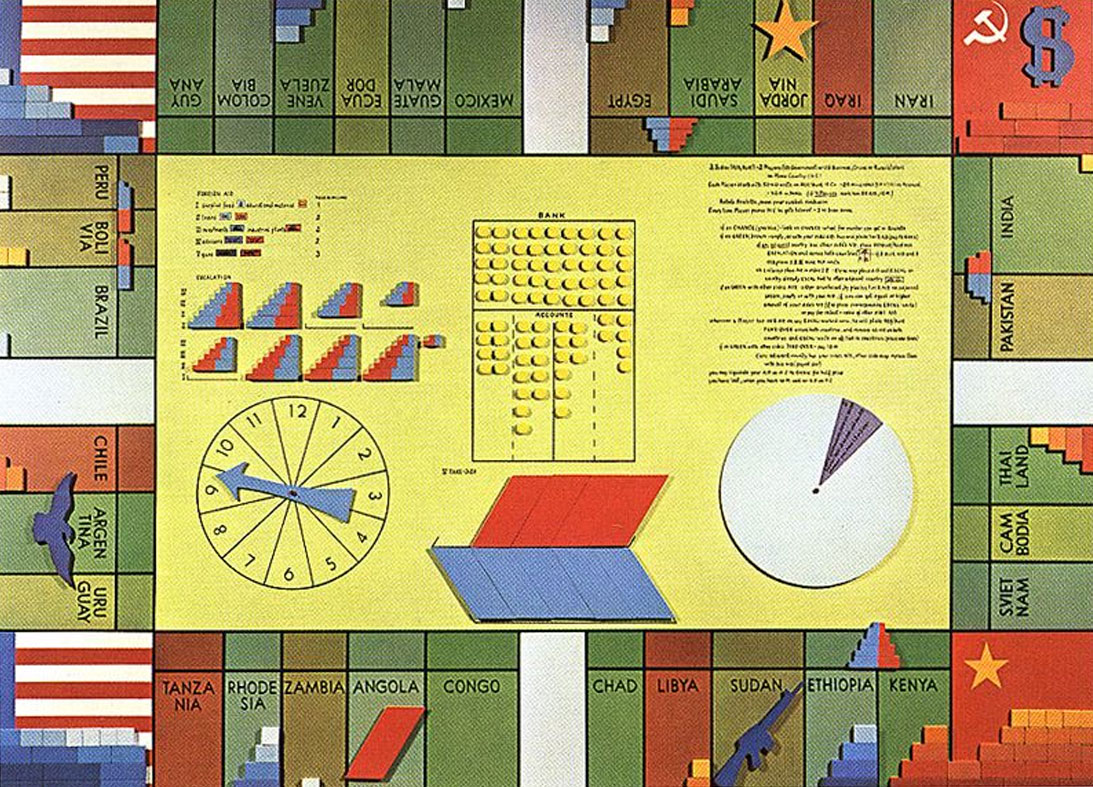
From the perspective of a neutral, the Swedish Fahlstrom brings a cool, incisive and avant garde eye to the Cold War – that ghastly period of the nuclear arms race, Mutually Assured Destruction (MAD), rabid anti-communism (etc) that dominated our youth in the 1960s. In the development of MAD, the think-tanks that built US cold-war policy (the RAND Corporation, the Hudson Institute) used von Neuman and Morgenstern’s Theory of Games to explore strategic decision-making. This philosophical investigation gave rise to concepts like zero-sum and non-zero sum games, the prisoner’s dilemma, and the idea of mutually assured destruction – a set of ideas satirised bleakly in Kubrick’s Dr Strangelove (1963). Here Fahlstrom takes the ever-popular Monopoly board game and casts it in the frightening equations of cold-war thinking. Fahlstrom was one the most important multi-media artists emerging in the 1960s. While in New York, he worked with Robert Rauschenberg and Billy Kluver in their Experiments in Art and Technology (EAT) events and happenings.

Robert Rauschenberg: Booster and Seven Studies 1970

Robert Rauschenberg: Booster and Seven Studies 1970

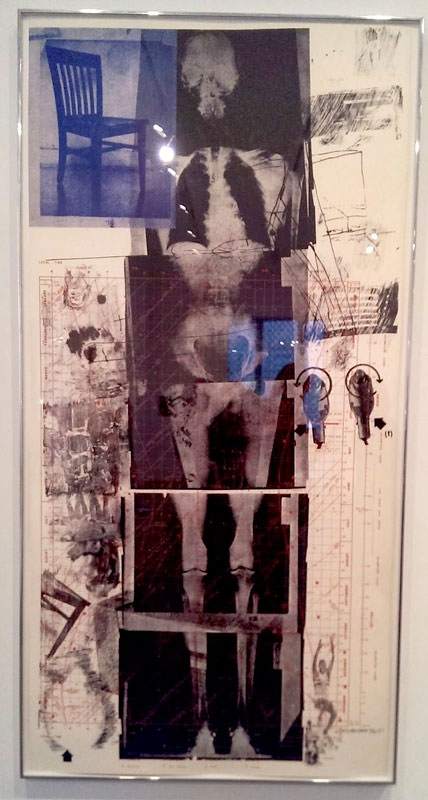
Rauschenberg has been a key transliterator of the zeitgeist since the early 1960s, maybe even before. I love his ‘expanded prints’ of the 1970s, especially this life-size self portrait in x-rays. Like April Greiman’s full-size body scan of 1987, Rauschenberg’s image is made of several individual images collaged together, with annotations, sketches and notes appended to the image. I remember seeing his set of illustrations/interpretations of Dante’s Inferno at the Tate (or was it the Whitechapel?) in the mid-1960s, and being bowled over by the poetry of his simple use of solvent to make rubbings from commercially printed magazine images.

Morton Heilig: Sensorama 1957

Morton Heilig: Sensorama 1957

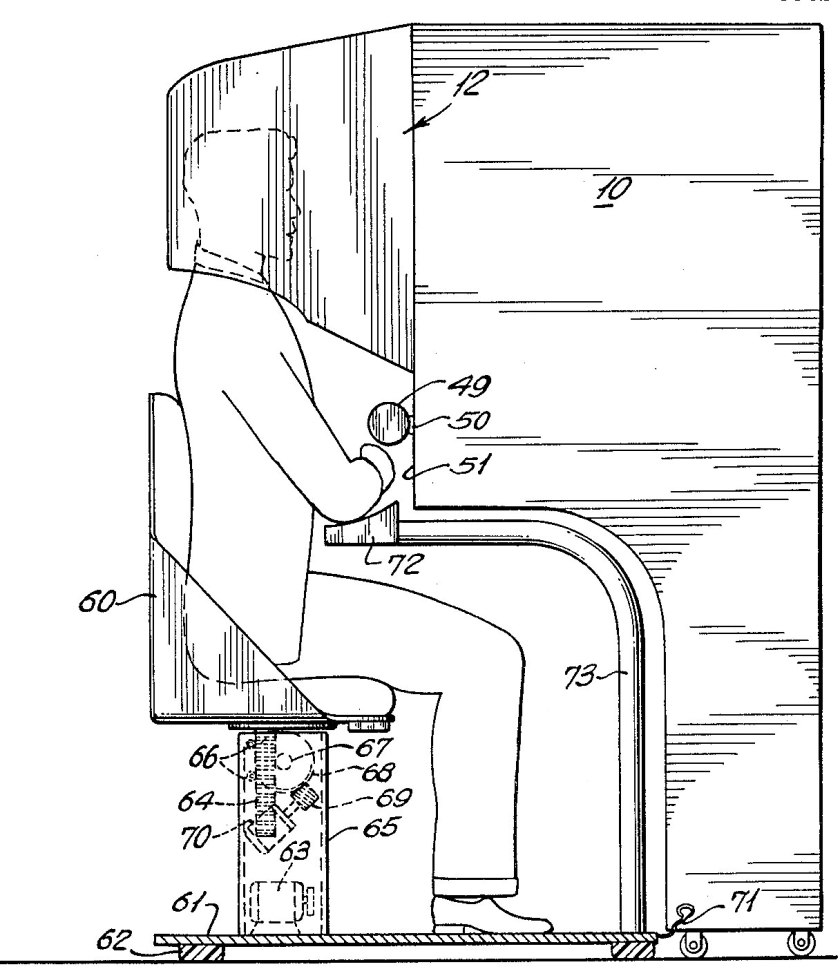
Heilig had a background in cinematographic projection. Impressed by Fred Waller’s work on Cinerama – a three-projector wide-screen cinema system  introduced in 1950, Heilig realised the potential of the immersive cinema experience. And he wanted to engage his audience sensorially – with senses beyond those of sight and sound. In 1957 he makes the Sensorama, and arcade-style entertainment. Sensorama was an electro-optical-mechanical motor-cycle-ride simulator. The user sat on – or in – the machine, looking at back-projected movie footage shot from a motor-cycle driving around New York. The user’s handlebar controls caused the film to speed up or slow down as the throttle was twisted, a fan accelerated air – with occasional whiffs of carbon monoxide – over the user. The sound effects were stereo – inside the hooded cowl of the simulator. The visuals were immersive, the seat shaking, the whiffs of Manhattan in the rushing air. This is really the most advanced simulator before virtual reality technology was made user-friendly in the early 1990s. Heilig was an important innovator in the artist’s perennial quest to engage an audience both multi-sensorially and immersively – a quest whose first signs – storytelling, dance and drama around the tribal fire – appeared perhaps in the neolithic, perhaps even earlier. The best description of Heilig’s work, and extensive interviews with him are in Howard Rheingold’s Virtual Reality (1991).