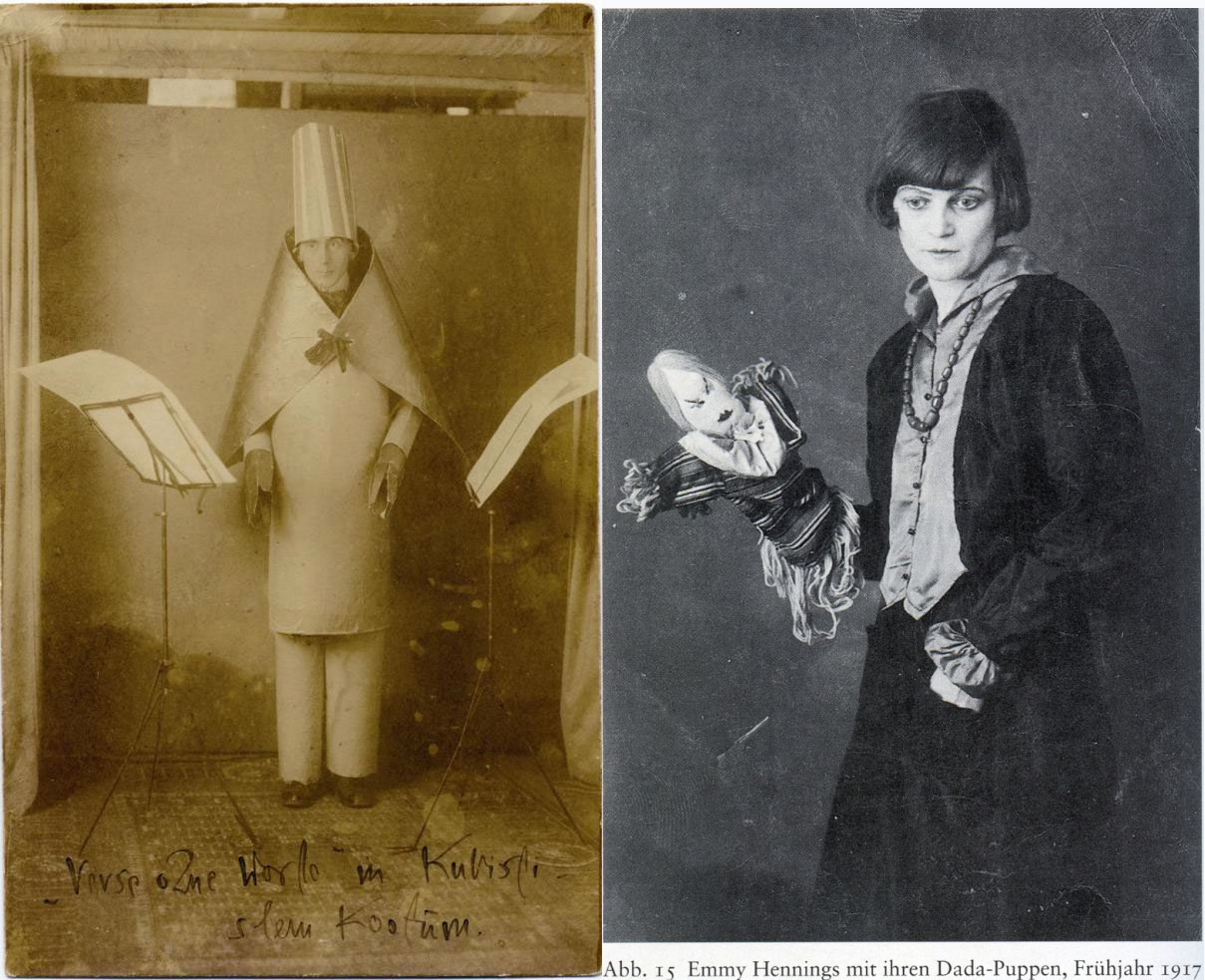
Hugo Ball + Emmy Hennings: Cabaret Voltaire 1916

Hugo Ball + Emmy Hennings: Cabaret Voltaire 1916

Why does this inspire?
In the face of almost universal War fever, a theatrical bohemian called Hugo Ball and his partner Emmy Hennings set up a nightclub for anti-war intellectuals and avant garde artists who have decided to sit out the War in Switzerland. The DADA movement grew from this humble beginning. I’ve often wondered if James Joyce, and Albert Einstein, who were both in Zurich around this period, ever went to the Cabaret Voltaire.. What did it feel like to be there? Would you have been aware that history was being made?

“In 1914, when I was thinking over the plan for a new theatre, I was convinced of this: a theatre which experiments beyond the realm of day to day preoccupations. Europe paints, composes and writes verse in a new way. A fusion, not merely of all art, but of all regenerative ideas. The background of colours, words and sounds must be brought out from the subconcious and given life, so that it engulfs everyday life and all it’s misery.” (Hugo Ball)
“In 1915, Hugo Ball became the chief organiser of the Cabaret Voltaire, a club that attracted expatriot artists and intellectuals in Zurich to escape World War  Ball wrote of Cabaret Voltaire “I was sure that there must be a few young people in Switzerland who like me were interested not only in enjoying their independence but giving proof of it. Cabaret Votaire, which has as it’s sole purpose to draw attention, across the barriers of war and nationalism, to the few independent spirits who live for other ideals”
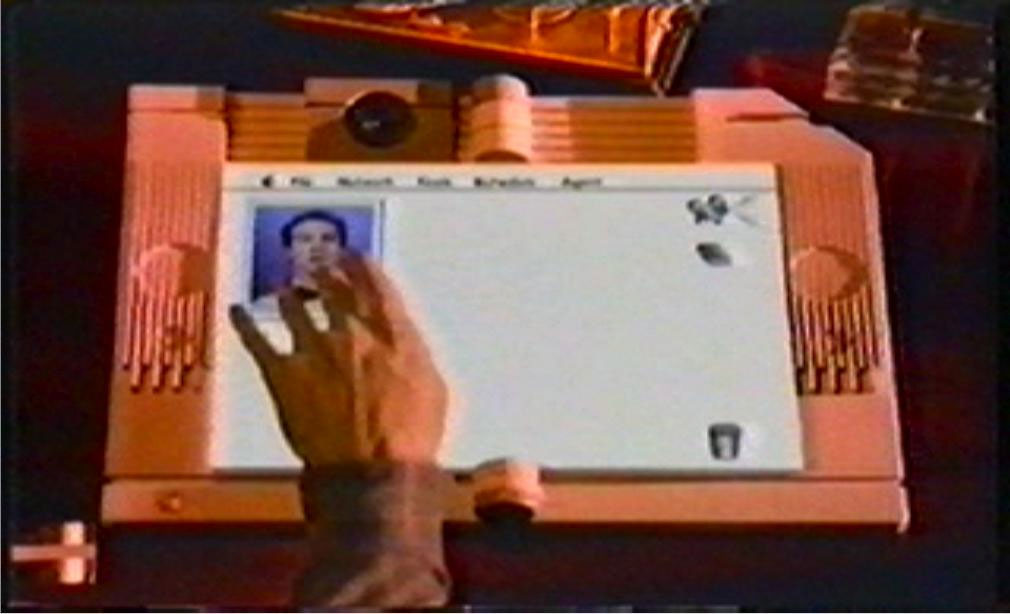
John Sculley + Doris Mitsch: The Knowledge Navigator 1991

John Sculley + Doris Mitsch: The Knowledge Navigator 1991

A classic example of the ‘virtual prototype’ – the convincing illustration of a concept – in this case Apple CEO John Sculley’s 1990 vision of the future of computing. A future informed by Sculley’s Apple Technology Group colleagues of the time: Bill Atkinson, Alan Kay, Brenda Laurel, Glorianna Davenport… It was a vision that has not yet been realised (though we are getting close). The idea of personified intelligent agents able to act on our behalf was a popular theme at the time – see also Dougllas Adams’ Hyperland video. But Apple’s 2013  Siri – the current version of the Personal Digital Assistant (or smart software agent), while not an animated, personified character,is getting better. And 30 years of developments in AI since the Knowledge Navigator are beginning to show. Sculley and Mitsch’s virtual prototype remains a powerful vision of the future as seen from 1991, and is as seminal as Alan Kay’s 1968 vision of the Dynabook.

John Heartfield +George Grosz: Life and Work in the Universal City 12.05 Noon

John Heartfield +George Grosz: Life and Work in the Universal City 12.05 Noon

Helmut Herzfelde, son of a Marxist and Trade Union leader, had worked as a designer between art school in Munich and Berlin, and during the war contributed to Die Nieue Jugend, an art journal edited by his brother. Drafted into the army for military war service, he meets George Grosz. In 1916 in protest at the war he changes his name to John Heartfield. His contributions to Die Nieue Jugend, begin to include fragments of printed photographs and graphics (type and image). This new style of work in which drawings are annotated with cut-out photographs and magazine reproductions, is later called photo-montage.

Maya Deren: Meshes of the Afternoon 1943

Maya Deren: Meshes of the Afternoon

Daughter of an emigre Ukrainian psychiatrist, Maya Deren was a talented dancer, choreographer, poet and photographer who became a leading proponent of an avant garde genre of film-making (dubbed Trance films by some) that used the camera as a tool for psycho-sexual self-investigation. Christened Eleanora Derenkowski, she adopted the name Maya Deren in 1943, the same year she made her first and best-known film Meshes of the Afternoon with her second husband, the photographer Alexander Hammid.
With this, and the other films she made in the 1940s, in which she often acted, scripted, and choreographed (as well as conceiving and directing) Maya Deren established herself as a pioneer of the American Avant-Garde, with her Trance films sub-genre influencing a string of counter-culture film-makers including Kenneth Anger (Scorpio Rising 1964), Curtis Harrington (Fragment of Seeking 1946), and Stan Brakhage (Dog Star Man 1961).


Fritz Lang: Metropolis 1927

Fritz Lang: Metropolis 1927

This was not only the first real science fiction classic, it was the most expensive silent film ever made, costing approximately 7 million Reichsmark. Fritz Lang had been inspired by a 1924 visit to Manhattan. “I saw the buildings like a vertical curtain, opalescent, and very light. Filling the back of the stage, hanging from a sinister sky, in order to dazzle, to diffuse, to hypnotize.” The film is set in the future (2026), when mankind is split into two interdependent factions: the thinkers who plan and live in luxury but have no technical skills, and the workers who live underground creating the wealth that the thinkers benefit from. The screenplay was co-written in 1924, by Lang and his wife and long-term collaborator Thea von Harbou, it seems to borrow ideas from Capek’s RUR (1921), and echoes themes of HG Wells The Sleeper Awakes and Mary Shelly’s Frankenstein. The film was originally 153 minutes, but was cut for release in USA, and subsequently about 25% of the original has been lost. However, with current releases on DVD (and versions on youtube) you at least get some idea of the immense vision of the original – the dramatic robot and the cityscape sets are spectacular. The spectacular transmutation of robot and woman (Maria) are still powerful optical effects.

Henry Pickering Bowditch: 12 Boston Doctors and their Composite 1892

Henry Pickering Bowditch: 12 Boston Doctors and their Composite 1892

I suppose composite portraiture like this is a natural and logical outcome of the 19th century mindset, and its fascination with typologies, phrenology, the science of physiognomy, and the early theories of eugenics (by another influential composite portraitist and eugenicist Francis Galton. The idea that composite portraits would reveal the essential archetype or ur-type of a group of professionals seems fanciful now, but the explorations of digital imagist Nancy Burson 100 years after Bowditch and Galton are still fascinating. These composite portraits are further examples of the emergence of a photographic aesthetic in the 19th century that very much foreshadows modern digital imaging practice – layering images, and compositing special effects.

Alexander Rodchenko: The Living Badge 1923

Alexander Rodchenko: The Living Badge 1923

For many years, the work of the painter, constructor, photographer and graphic designer Rodchenko was under-rated. It is almost as if we had to live through at least part of our current multimedia aesthetic environment before we could fully appreciate the importance of Rodchenko and his other eminent contemporaries, Tatlin, Klucis, Chashnik and Malevich. The Living Badge from 1923 is a parade float extolling the health and beauty of the Russian people.

Pet Shop Boys + Matthew Dunster (et al): The Most Incredible Thing 2011

Pet Shop Boys + Matthew Dunster (et al): The Most Incredible Thing 2011

With choreography by Javier de Frutos, scenography by Matthew Dunster, and an electronic score by the Pet Shop Boys, this is a highly contemporary weaving together of (Hans Anderson’s) fairytale, of classical and modern forms, inspired visually by Russian constructivist graphics and art (especially a flavour of Alexander Rodchenko (see The Living Badge post). Click on the image for the complete BBC4 broadcast of June 2011.

Romke Faber: Previz 2009

Romke Faber: Previz 2009

Faber was diagramming the impact of Pre-Viz software on the typical feature film workflow. PreViz is software that combines and replaces several creative stages in Film Pre-Production – storyboard and animatic capabilities to calculate and visualise suitable camera angles, positions, movements, and to sketch the basic mise en scene and actors positions and movements. Nowadays, pre-biz software – easy to use 3d modelling and rendering software based on the production of animatics – such as Frame Forge Studio, Mesh, Moviestorm – point the way to new film-making workflows more in tune with the digital world.

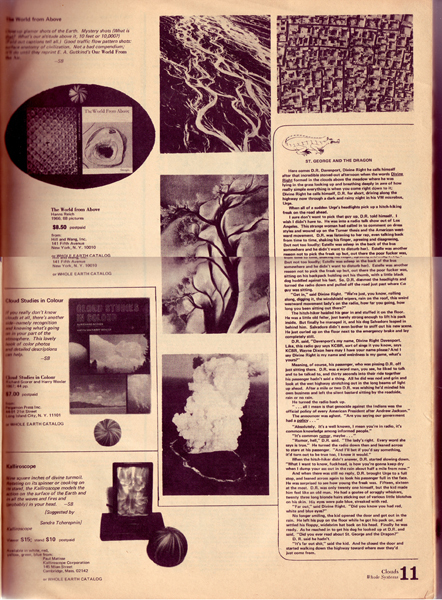
Stewart Brand: The Whole Earth Catalog 1968

Stewart Brand: The Whole Earth Catalog 1968

This (offset-litho/paper) catalog was the ‘World Wide Web’ of the late 1960s – a repository of content linked by the zeitgeist concerns of the counter-culture: ecology, environment, counter-culture, anti-war etc… contributions from hundreds of people, edited by Brand (later to write The Media Lab: Inventing the Future at MIT). The Catalog was a mail-order catalogue (note that the civilisation of the American West was based on mail-order catalogues, such as Sears Roebuck (from 1894). But it was a mail order catalog aimed at and created by a younger generation who were exploring a different curriculum – a counter-curriculum – to the conservative, capitalist, military-industrial world of the older generation. Typically the Whole Earth Catalog had sections on ‘Understanding Whole Systems’, Farming, Husbandry,Self-Suffiency, Shelter, Arts and Crafts, Surfing, Sailing, Music, Computing, Philosophy – in fact the whole gamut of areas of interest to the counter-culture. Brand was seminal in the San Francisco counter culture, and after WEC went on to found the first electronic community (the Whole Earth ‘Lectronic Link (WELL) in 1985 (8 years before the WWW really got going). Fred Turner has documented his life and work in From Counterculture to Cyberculture – Stewart Brand, the Whole Earth Network and the Rise of Digital Utopianism (2006).