Karel Capek/; Rossum’s Universal Robots (RUR) 1921

Karel Capek/; Rossum's Universal Robots (RUR) 1921

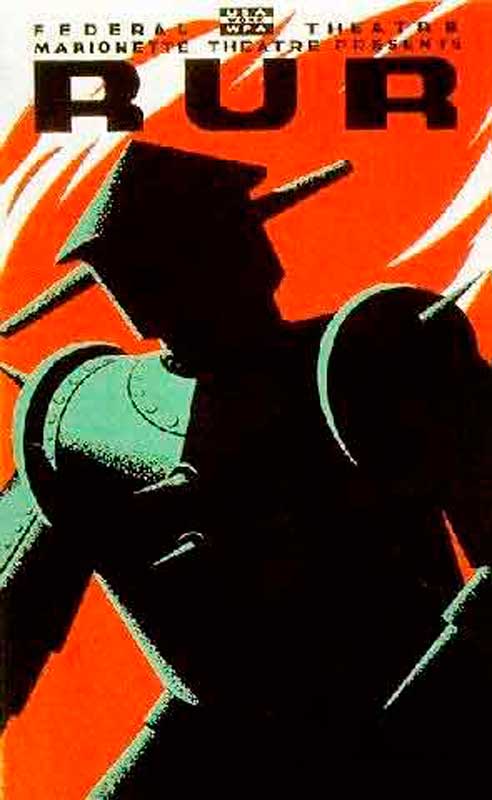
Karel Capek published Rossum’s Universal Robots in 1921, simultaneously inventing the word Robot, and creating a science-fiction tradition in Czechoslovakia. Robot is derived from the Czech Robota – which can mean work you don’t really want to do, or work that is tedious. His play has been performed around the world, and the word Robot was subsequently made really famous by Isaac Asimov in the 1940s (stories collected as I Robot 1950).

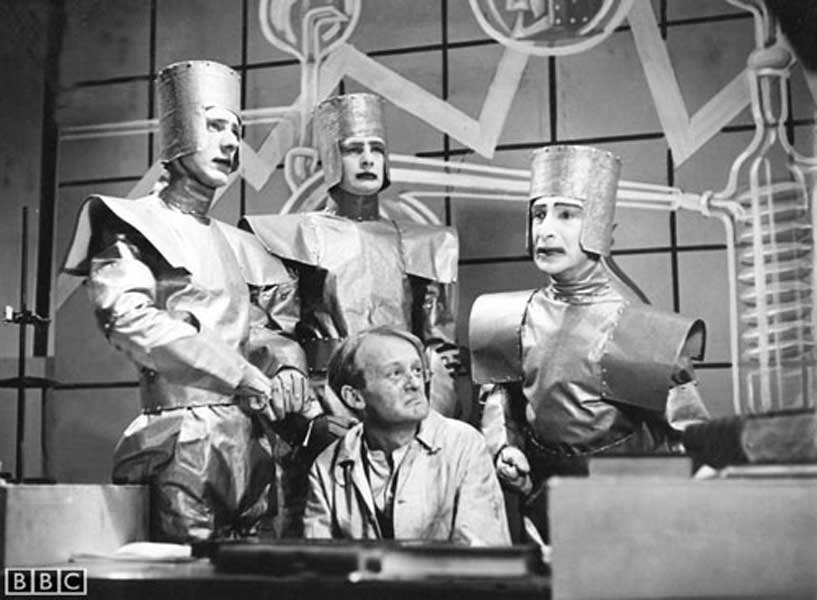
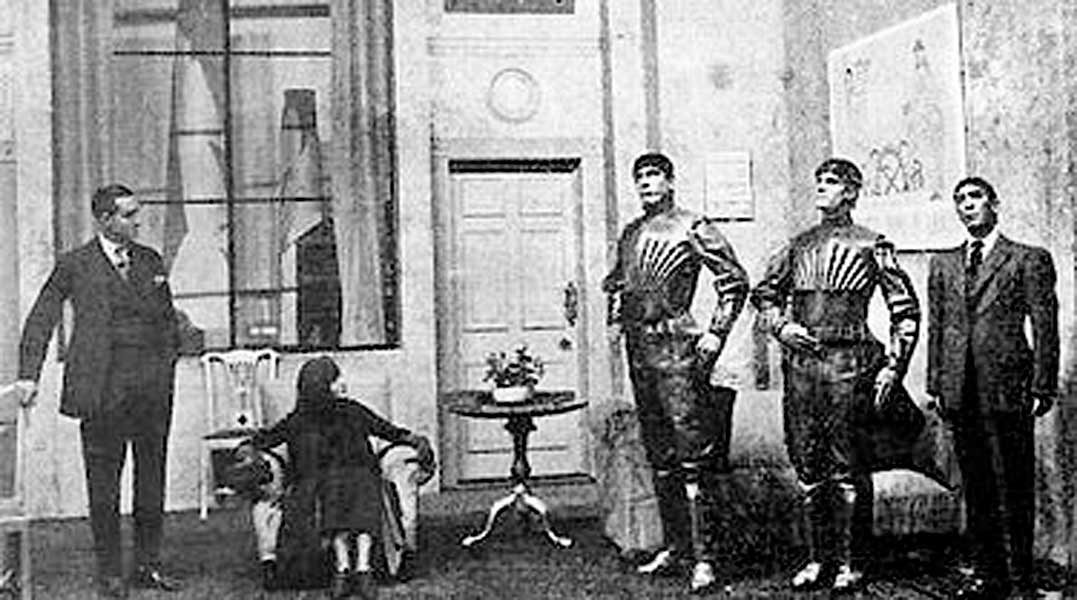
In 1938, the BBC’s nascent Television Centre produced a version of RUR (picture below).

Also in 1938, Richard Buckminster Fuller in his book Nine Chains to the Moon, describes a man as:
“A self-balancing, 28-jointed adapter-base biped; an electro-mechanical reduction-plant, integral with segregated stowages of special energy extracts in storage batteries, for subsequent actuation of thousands of hydraulic and pneumatic pumps, with motors attached; 62,000 miles of capillaries; millions of warning signal, railroad and conveyor systems; crushers and cranes (of which the arms are magnificent 23-jointed affairs with self-surfacing and lubricating systems, and a universally distributed telephone system needing no service for 70 years if well managed); the whole, extraordinarily complex mechanism guided with exquisite precision from a turret in which are located telescopic and microscopic self-registering and recording range finders, a spectroscope, et cetera, the turret control being closely allied with an air conditioning intake-and-exhaust, and a main fuel intake.”

1938_BBC_RUR_tv_c

1938 BBC Television  produce RUR as a tv play
1921_Capek_RUR_scene_c

Early 1920s – an early production of the play RUR.

By the 1940s the word Robot was popularised world-wide by the American sci-fi writer Isaac Asimov, who writes a series of books featuring advanced robots including I, Robot, and invents his Three Laws of Robotics. During the period 1950-2000, robots went from fiction to fact, a causal chain perhaps beginning with Grey Walter’s Tortoise autonomous robots in 1949. Coeval with Robotics, the science of artificial intelligence (including machine-vision, machine reasoning, voice-recognition, speech synthesis, Turing-test programming, software agents, etc etc) developed and splintered into a variety of sub-specialisms. From the late 1940s, we have another parallel and overlapping science – that of cybernetics – ‘command and control in man and the machine’ (Weiner 1948). It was the convergence and synergetic outcome of these three disciplines (robotics, AI and cybernetics) that put us on the road to the eventual  creation of what Hans Moravec calls an ultra-intelligent machine.

In 2013 alone, 179,000 industrial robots were sold worldwide.
 

Storm de Hirsch: Peyote Queen 1965

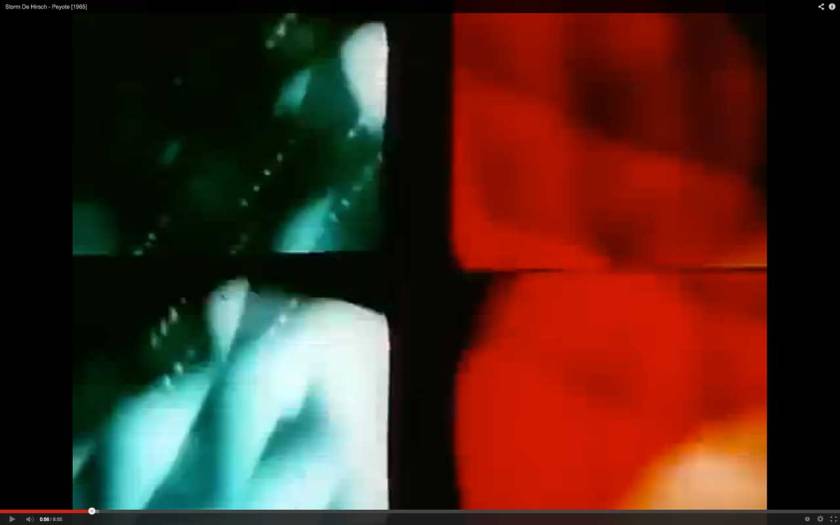
Storm de Hirsch: Peyote Queen 1965

Storm de Hirsch was a mature artist when she made her first feature – Goodbye in the Mirror, shot on 16mm – in 1963. Born in 1912, she was five years older than the doyenne of the American avant garde, Maya Deren. And de Hirsch, like Deren, was an experimentalist, with a background as a painter and a poet. Many of her short films she made are abstract, some are made without a camera – with de Hirsch scratching, painting and etching directly onto film, sometimes using multi-screen prints, some with in-camera masking or matting.
The best biography of this under-appreciated film-maker is at http://www.filmdirectorssite.com/storm-de-hirsch

What makes artists and film-makers like Storm de Hirsch important in the back-story of 21st century media? Because the avant garde were the first to seize the opportunity of new media to explore new ways of communicating and expressing their ideas. There is a techno-aesthetic exploring the areas of synaesthesia, immersion, interactivity, and multi-sensory communication that permeates the recent history of our culture, from the Phantasmagoria of the early 19th century to the immersive, multi-sensory, multi-media forms of the Happening and Dance Rave culture of the 1990s, but this desire of artists to enrapture their audience must be traced back to the neolithic – to the primordial dance-ritual, storytelling, oral culture of pre-history.

Peyote Queen was made when abstract expressionism was just giving way to pop art as the dominant fine-art form. De Hirsch nods towards both styles, but is suffused throughout by a celebration of the primitive – of percussion, abstraction, symbolism (the ankh, the cross, the crescent, the yin-yang) as well as simple punched holes, scratched graffito of lips, tits, hearts, eyes, flowers, and the evocative kaleidoscopic effects of distorting mirrors, dimpled glass, prisms, and the organic distorted close-ups of faces, hands, drumming. The sound track is jazzy, percussive, Caribbean, burlesque, and the movie is cut on the beat (or having that effect).

http://www.youtube.com/watch?v=6wh83QviDBQ

Winsor McCay: Little Nemo in Slumberland 1910

Winsor McCay: Little Nemo in Slumberland 1910

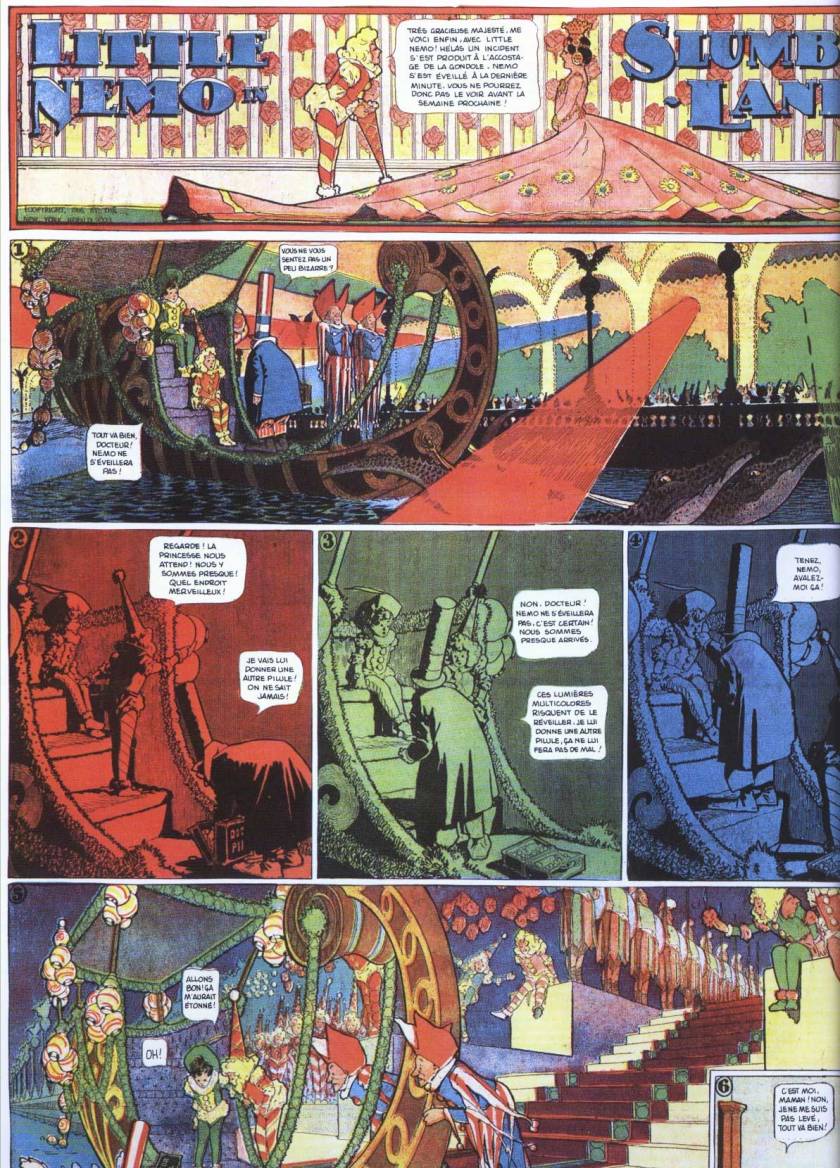
Winsor McCay had already established his reputation as a comic-strip artist with his creation of Little Nemo in Slumberland  – an art nouveau comic strip reproduced in full colour and syndicated around the world – when he began to extend and enhance his drawings into animated films, live lectures and stage performances with projected images. McCay’s storytelling genius – the seemingly endless variations of what happened every night between Little Nemo falling asleep and waking up in the morning – is revealed in this masterpiece of visual narrative – his ‘framing’ just beginning to reflect the innovations in lenses and cinematography introduced in the previous decade or so. Look at the page above – the storyboard-cinematographic framing and styling, even the colour gel ‘tints’ used to colour monochrome frames – all reveal how much McCay was aware of the explosion of imagery he was witnessing at the end of the Belle Epoque.

His very original conversion of Little Nemo to an animated film (1911) is a landmark in the history of animation. McCay combines live-action, over-the-shoulder live-action drawing, frame by frame animation, cell-colouring and captions in this lively essay on the art of drawing animation. McCay’s Art Nouveau style was not a great commercial success – his American immigrant audience preferring The Katzenjammer Kids, and other rough and tumble slapstick strips like The Brady Boys. But the standards of drawing, colouring and animation set by McCay, make him immortal. McCay stands out above all other comic artists, for his delightful and quintessential Art Nouveau drawing and colouring, but it is the imaginative animation that inspires. Like Norman McLaren some 30 years later, McCay is not afraid to improvise and innovate. In Little Nemo, he combines frame-by-frame drawing, live drawing to camera, live action, colour and caption – mixing these styles to both capture the magic of animation, and hinting at his stage performances to be developed fully in 1914 with his Gertie the Dinosaur shows. The breakdown of the audiences’ cognitive framework – their suspension of disbelief – by revealing the technique of the animator and illustrator, is McCay’s original contribution to the history of animation.


Frank Miller + Robert Rodriguez: Sin City 2005

Frank Miller + Robert Rodriguez: Sin City 2005

This is one of the best remediations of a comic-strip to date. Rodriguez and Miller, with ‘guest director’ Quintin Tarantino, construct a computer-generated 3d world inspired by Miller’s original drawings, perspectives, camera movements and framing, that echo Miller’s visual-narrative style, and screen characters that subtly blend the talents of the actors with the visual drawing-style of Miller, and integrate all these elements together with ‘spot colour’ and film-noir black and white…

Miller has all the draftsmanship talents of the great originators of the modern comic – especially Will Eisner, whose character The Spirit occupies similar laconic underworld story-space as those of Frank Miller.

Charlie Parker: Bebop Jazz 1939-1945

Charlie Parker: Bebop Jazz 1939-1945

Charlie Parker, Dizzy Gillespie, Miles Davis et al: Bebop Jazz  1939 – 1945

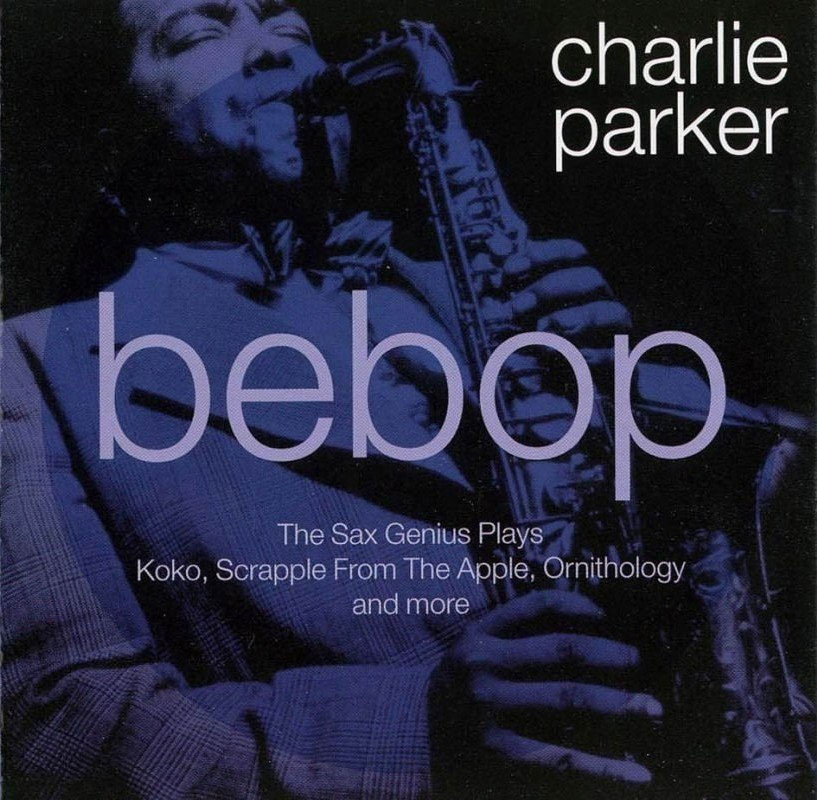
Bebop jazz was probably the first iteration of ‘modern jazz’ (though Louis Armstrong had introduced the extended improvised solo in the 1920s) – Bebop was the first non-dance jazz genre, characterised by improvisation, assymetric phrasing, solo instrumentals, scat singing, and intricate, ‘non-linear’ melodies. Bebop is associated with Charlie Parker, Dizzy Gillespie, Miles Davis, Coleman Hawkins, Lester Young, Cannionball Adderley and Thelonius Monk. Later in the 1950s and 1960s, variants of Bebop like Cool Jazz, showcased by Chet Baker, Milt Jackson, Stan Getz, Dave Brubeck became very popular. The individual – the solist – takes personal control of the shape of a piece of music, themically linking it to a base tune or melody, but freely improvising around that basic theme. An inspirational model for creative innovation…. My favorite post-Bebop saxophonist is the great John Coltrane.

Bebop had its own distinctive ‘cool’ graphics  BlueNote Records with sleeves designed by Reid Miles and photographs by BlueNote co-founder Francis Wolfe, set a distinctive style in graphics, breaking new ground in display typography, hinting at Swiss School breakthroughs, effectively defining the style of jazz albums thereafter. 

Tom Philips: A Humument 1970 (book) 2011 (app)

Tom Philips: A Humument 1970 (book) 2011 (app)

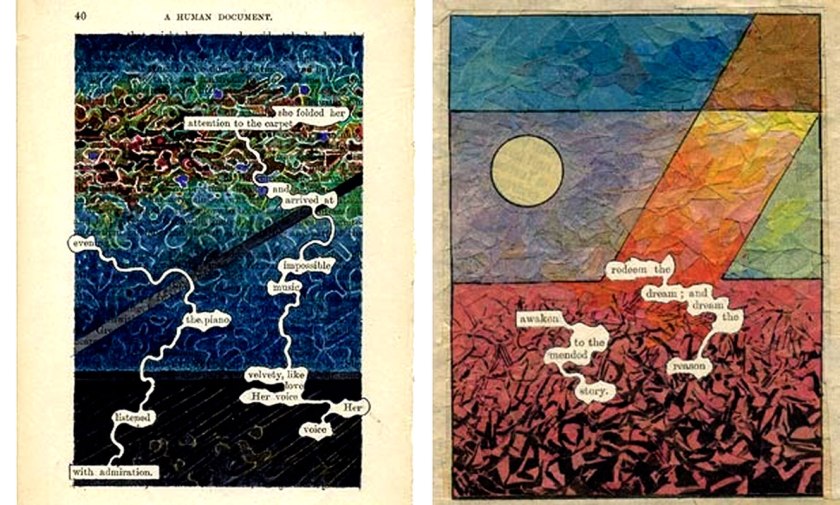
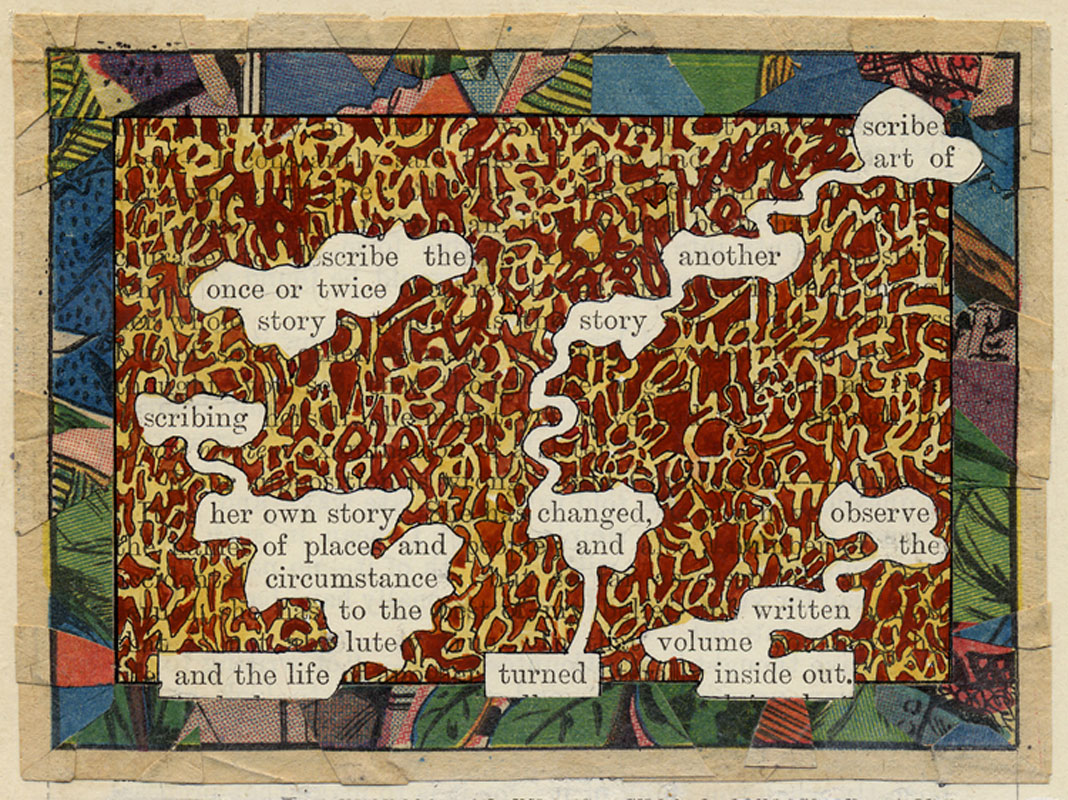
Tom Philips is one of those leading artists not bound to a personal style or signature methodology. His work is fascinating, various, eclectic and always just right. A Humument is an experiment. It involves creating new texts and readings from an existing book, in this case A Human Document by W.H. Mallock – an obscure novel that Philips bought for 3 pence in a Furniture Repository in Peckham Rye.

He writes:

“Like most projects that ended up lasting half a lifetime, this work started out as idle play at the fringe of my work and preoccupations. I had read an interview with William Burroughs (Paris Review 1965) and, as a result, had played with the “cut-up” technique, making my own variant (the column-edge poem) from current copies of the New Statesman. It seemed a good idea to push these devices into more ambitious service. “

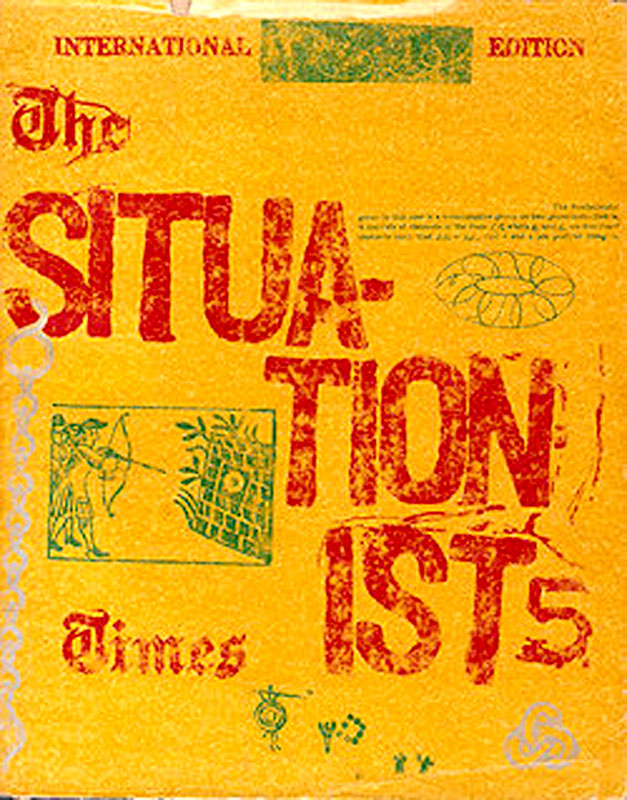
Jacqueline de Jong: Situationist Times 1963

Jacqueline de Jong: Situationist Times 1963

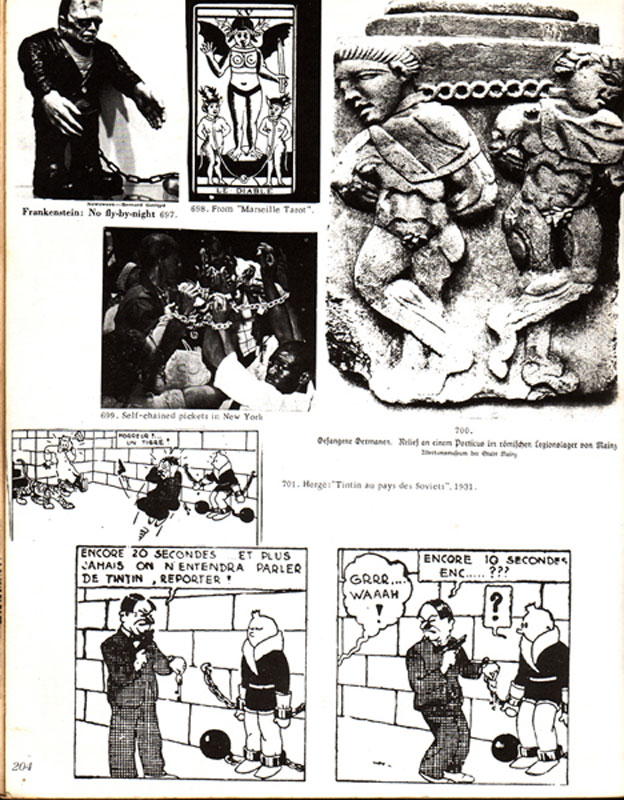
“Editors Note: In this No. of the Situationist Times (5) do we try to open up the problem of the ring, interlaced rings and consequently chains. This happens on the base of the three patterns of European culture which are introduced in Jorn’s article on ‘Meaning and Sense’….All we try to show here in an artistic way is a certain connection of the three patterns with topological aspects. It is up to the reader if he wants so, to make his own conclusions.”

This how the editor Jacqueline de Jong sums the contents of issue No 5 of the Situationist Times – a journal in letter-format (220x280mm). A total of 6 issues were published by de Jong from Paris and Copenhagen in 1600 copies per issue between May 1962 and December 1964. The article by the Danish artist Asger Jorn: Mind and Sense – on the principle of ambivalence in nordic huisdrapa and mind singing – is Jorn’s attempt to validate and evangelise the importance of Nordic Art in the face of Denmark applying to join the European Union (a process that began in 1961). After a three-page (2500-word) article, explaining the Nordic artist’s role as a shaman, the issue is a non-linear collage of images related to the theme of the “ring, interlaced rings and consequently chains”, with essays on the mathematical aspects, the history, mythology and symbolism, magic circles, games with hoops and rings. It is fascinating.

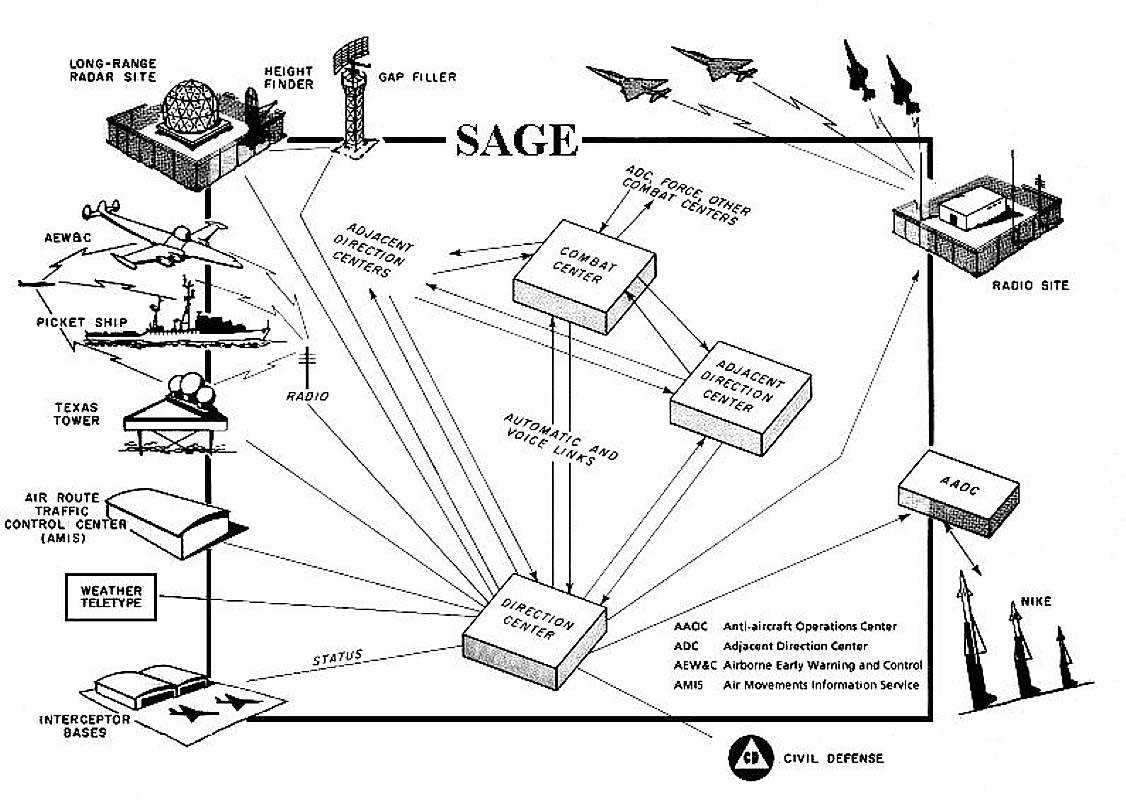
US Government: SAGE (Semi-Automatic Ground Environment) 1963

US Government: SAGE (Semi-Automatic Ground Environment) 1963

1963 saw the culmination of a decade-long program to build an air-defense system to protect the North American continent against attack by bombers. SAGE was the first integrated national computer-telecoms system. It was designed to expedite communications between early-warning (DEWLINE) long-distance RADAR, air-observation units, strategic command head-quarters, and the fighter, anti-aircraft and missile defence resources around the USA and Alaska.

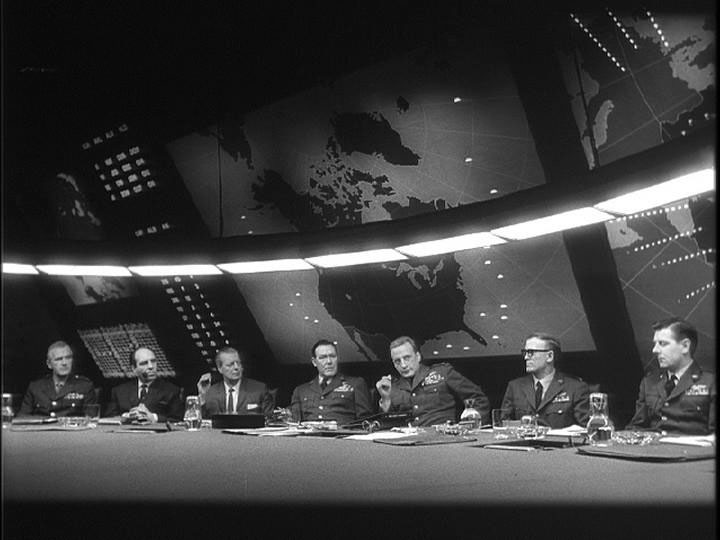
This elaborate, computer-controlled national network formed a major part of the MAD nuclear strategy (Mutually-Assured Destruction – the idea that any nuclear offensive would be met by an automatic nuclear retaliation.) These systems and this strategic policy were mercilessly and hilariously satirised in the Stanley Kubrick’s 1963 movie Dr Strangelove (Or How I Learned to Stop Worrying and Love the Bomb), and more seriously, and less successfully,  perhaps in Sidney Lumet’s Fail Safe (1964). However these integrated systems informed similar systems like the UK National Air-Traffic Control (1962), and arguably, the ARPANET-Internet (1969-77).

Ken Adam designed the Pentagon War Room set for Dr Strangelove – an amazing and prescient vision of how large projectors and computer-data visualisation might look in the near future. It looked so realistic that apparently the Russians were seriously worried by the apparent IT gap! And 30 years later, when Reagan got to be President, he was most disappointed that the War-Room looked nothing like Ken Adam’s vision.

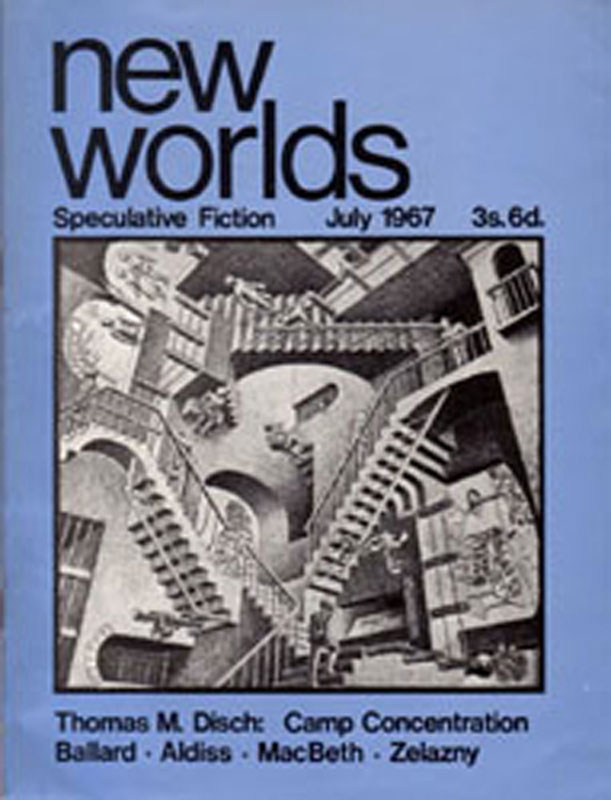
Michael Moorcock (ed): New Worlds SF 1967

Michael Moorcock (ed): New Worlds SF 1967

Moorcock took over the editorship of New Worlds in 1964, and a few years later, he was managing a magazine that had seized the zeitgeist head-on. In this August 1967 issue, the cover features the work of Eduardo Paolozzi – the Scottish Italian sculptor and ‘co-inventor’- of Pop Art (with his contemporary Richard Hamilton). This was one of a tiny bundle of magazines that in one way illustrated and in another way formulated, the spirit of the age. These included Architectural Design (AD), Oz magazine, International Times (IT), Rolling Stone (in its original low-print-cost, newsprint-paper, offset litho form), and of course New Worlds SF. New Worlds received a small annual grant from the UK Arts Council in recognition of the fact that Moorcock was featuring the best speculative fiction, articles about modern art, philosophy, science. It was a monthly fix of what was happening in the late 1960s – in poetry, fiction, SF, art, thought.

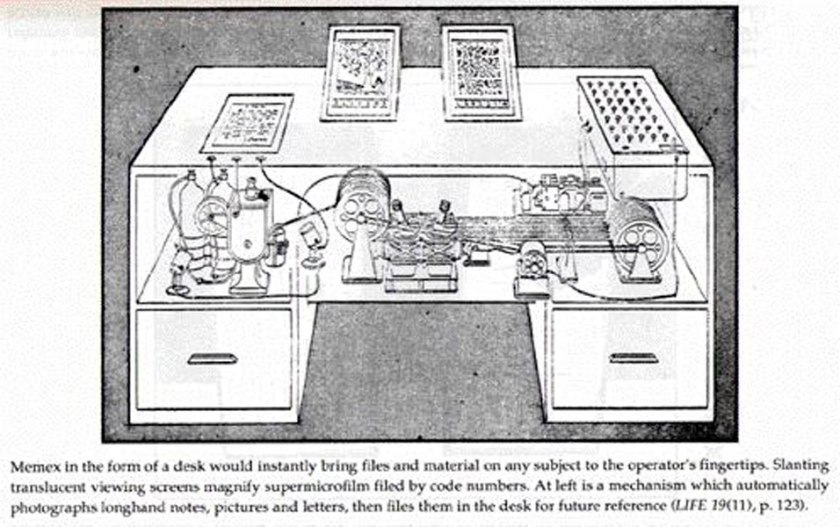
Vannevar Bush: Memex 1945

Vannevar Bush: Memex 1945

Bush was chief science advisor to President Rooseveldt in WW2, and as such he had to examine thousands of proposals, inventions, papers, reports, and condense all these for the US cabinet. At the time Bush only had filing cabinets and card-index systems to help him sort and archive these documents. He dreamed of a filing system that would echo the way we actually think – the sequence of associative ideas that we create in our minds.

Immediately after the war, he himself wrote a paper, published in the influential Atlantic Monthly, entitled As We May Think. In this article he described an experimental memory-extension machine he had devised, called the Memex. Memex could store records (files), our notations,  and ‘associations’ – the conceptual links with other documents that made them a valid expression and communication. This machine could scan documents, make copies of them on microfilm, archive them with an index number, and retrieve them on demand, either by browsing through the archive, by typing a keyword, or by clicking on a link from one archive document (record) to another. Not only that, but the user could add notes and links to other Memex records, and if needed, build an associative  trail‘ of links connecting several or several dozen records together. He could then send this ‘trail’ of links to other Memex owners, so that they could follow the same logic, peruse the same evidence, the same diagrams, the same pictures.

Yes – Vannevar Bush described a hypothetical hypertext machine in 1945, some twenty years before the hypertext pioneer Ted Nelson coined the actual word. Now we all have computer-based personal digital assistants – our own Memex machines, but we still can’t send his associative trails.