Robert Florey: The Love of Zero 1927

Robert Florey: The Love of Zero 1927

Florey’s short (15 minute) film, co-produced by Cameron Menzies, is a minor masterpiece, engagingly romantic in a Raymond Peynet (The Lovers) kind of way, Florey builds the extremely expressionist sets and lighting, uses avant garde film techniques (multiple exposures, fragmented crystal lenses, etc) creates a poetic surrealist fantasy: http://www.youtube.com/watch?v=aPEBUJJUICc

Alphonse Bertillon: self-portrait for the Bertillon photo-card identity system 1883

Alphonse Bertillon: self-portrait  for the Bertillon photo-card identity system 1883

By the 1880s, at last the 19th century fascination with phrenology, physiognomies and typologies of the human face found a outlet. In this system, dubbed Bertillonage after its inventor, we have a true anthropometrical approach, with the frontal and profile portraits (later called ‘mug shots’), being just one part of a complete system of photo-identity.

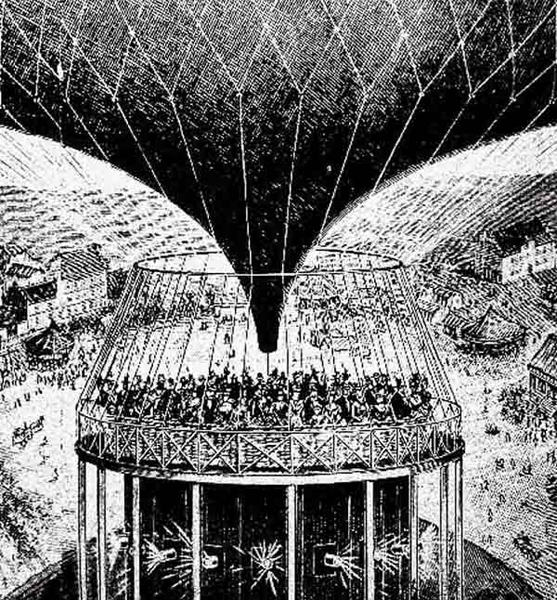
Raoul Gromoin-Sanson: Cineorama 1900

Raoul Gromoin-Sanson: Cineorama 1900

Raoul Grimoin-Sanson’s Cinéorama at the 1900 Paris World’s Fair was the first cinematic panorama, opened scarcely five years after cinema came into being. An early step in immersive experience and simulation, Gromoin~Sansion’s feature for Paris World Exposition of 1900, was a simulated balloon ascent over Paris. With this user-illusion in mind, the audience were seated in a vast gondola, while the illusion of aerial ascent was provided by 10 synchronised 70mm projectors, mounted under the gondal and projecting their images, taken from a real balloon ascending 400 metres over the Tuileries Gardens, onto a panoramic circular screen.

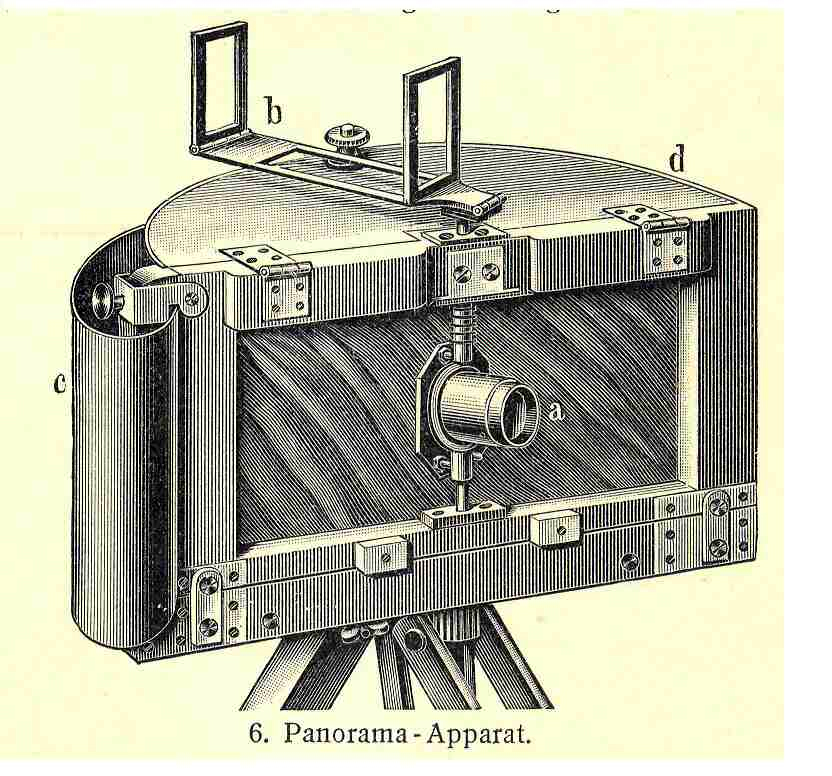
Joseph Puchberger: Panoramic Camera 1843

Joseph Puchberger: Panoramic Camera 1843

This Austrian invention kick-started a wave of innovation in cameras designed to rotate through 180 degrees while the shutter was open. The great grandfather of the motion control camera, the Quicktime VR stepped camera mount, this camera was superseded by a smooth-panning camera by Friedrich von Martens. After the invention of Wet-Plate Collodion process (Frederick Scott Archer 1851), ordinary cameras could be positioned manually and several prints made, to be mounted together into a panorama.

Oscar Gustave Rejlander: The Two Ways of Life

Oscar Gustave Rejlander: The Two Ways of Life

The photograph is a combination print, assembled from 30 individual negatives printed onto one large piece of paper. First exhibited at the Manchester Art Treasures Exhibition of 1857, the image proved controversial for its depiction of nude men and women in the same image. Queen Victoria, however, bought a copy for Prince Albert.