Zbigniew Rybczinkski: Tango 1980

Zbigniew Rybczinkski: Tango 1980

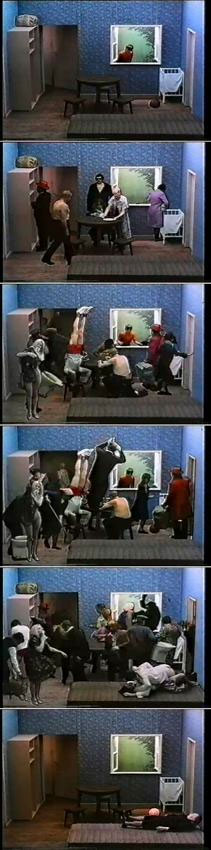
“Thirty-six characters from different stages of life – representations of different times – interact in one room, moving in loops, observed by a static camera. I had to draw and paint about 16.000 cell-mattes, and make several hundred thousand exposures on an optical printer. It took a full seven months, sixteen hours per day, to make the piece. The miracle is that the negative got through the process with only minor damage, and I made less than one hundred mathematical mistakes out of several hundred thousand possibilities. In the final result, there are plenty of flaws ® black lines are visible around humans, jitters caused by the instability of film material resulting from film perforation and elasticity of celluloid, changes of colour caused by the fluctuation in colour temperature of the projector bulb and, inevitably, dirt, grain and scratches.”

– Zbig Rybczynski –Looking to the Future – Imagining the Truth,” in Francois Penz, Maureen Thomas, Cinema& Architecture. Mliús, Mallet-Stevens,
David Hockney: 18-screen Wolds 2011

David Hockney: 18-screen Wolds 2011

Hockney has always explored new media, experimenting with imaging technologies like the Quantel Paintbox in the 1980s, the i-phone and i-pad drawing and painting apps (e.g. Brushes) more recently. He is also fascinated by Cubism, and has explored some of the ways in which artist’s represent the third dimension using optical tools, like mirrors, camera obscure and camera lucida. The multi-screen videos were made in the Yorkshire Wolds, the subject of many paintings, iPad drawings and video for his grand retrospective ‘A Bigger Picture’ at the Royal Academy in 2012.


Go back

Your message has been sent

Warning
Warning
Warning
Warning
Warning

Warning.

Tom McGrath, John (Hoppy) Hopkins, Allen Ginsberg etc: The International Poetry Reincarnation, Albert Hall, 1965

Tom McGrath, John (Hoppy) Hopkins, Allen Ginsberg etc: The International Poetry Reincarnation, Albert Hall, 1965

Allen Ginsberg reading Howl at the Royal Albert Hall, 1965. Though my favourite moments were when Harry Fainlight used a bow and arrow to loose his poem into the audience, and when the lady cinematographer was whirling her 16mm Bolex around her head, capturing zip panoramas of the oval interior of the Hall.
This was my first personal experience of the American/British/European ‘intermedia’ scene. It was part poetry reading, part party, part happening, and it presaged the whole Hippy thing (flowers given away outside Albert Hall). It decided me on the audio-visual ‘gesampkunstwerk’ route that became the central theme of my Diploma (DipAD) essay the following year.

Go back

Your message has been sent

Warning
Warning
Warning
Warning
Warning

Warning.

Jonas Mekas/The Living Theatre: The Brig 1964

Jonas Mekas/The Living Theatre: The Brig 1964

The Brig is a play written by former U.S. Marine Kenneth H. Brown (born 1936). It was first performed in New York by The Living Theatre on 13 May 1963 [1] with a production of it filmed in 1964 by Jonas Mekas. It has been revived in New York in 2007. It received an Obie Award.
The play depicts a typical day in a United States Marine Corps military prison called The Brig. Brown spent thirty days in a Brig for being Absent Without Official Leave whilst he was with the Third Marines in Camp Fuji Japan in the 1950s.” (wikipedia)

I saw this film in an all-night session on experimental ‘underground’ film at the BFI in the early 1970s. The staccato, dehumanised, robotic actions and the rigid military choreography and cruelty of the plot, reminded my of Antonin Artaud and his ideas of the Theatre of Cruelty. This movie is a visceral shock to the system, a saraband for McCarthyism, a premonition of the war in Vietnam, an essay of military elite training.

Stan Vanderbeek: Breath Death 1957

Stan Vanderbeek: Breath Death 1957

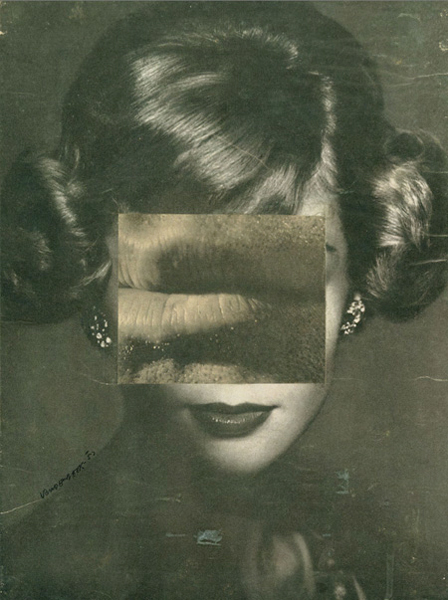
Vanderbeek’s early collages and animations were very inspirational and influenced the work of Terry Gilliam, John Stezaker and many other notable artists and directors. Vanderbeek transcended any identification with mono media. He was active in Film, Animation, Music, Archives, Immersive Events, Happenings and much more. Imagine going to College and having John Cage, Buckminster Fuller and Merce Cunningham as your teachers!

Stan Vanderbeek: MovieDome 1961

Stan Vanderbeek: MovieDome 1961

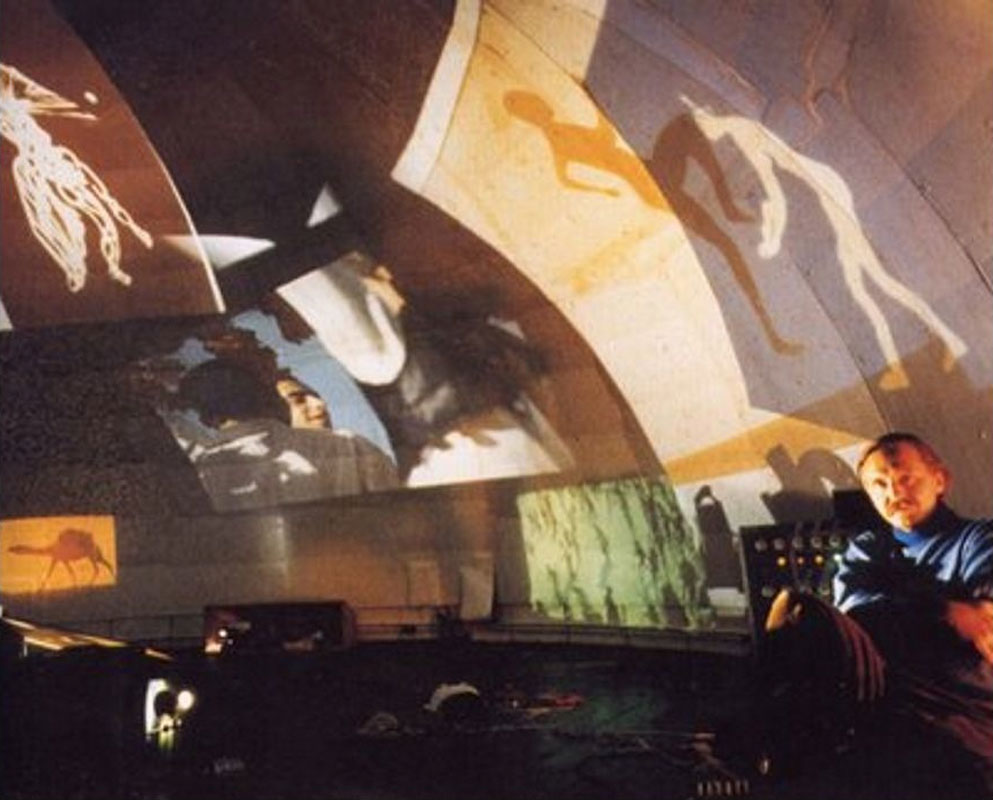
Vanderbeek was at Black Mountain College, contemporary with the experimental composer John Cage, the architect-poet-inventor Richard Buckminster Fuller and the dancer-choreographer Merce Cunningham. He experimented with immersive audio-visual environments, animation, computer-generated animation (with Ken Knowlton), he worked with the artist Claes Oldenburg and the the Happenings creator Al Hansen in the late 1950s and inspired by Buckminster Fuller’s domes, create his MovieDome at Stony Point New York in 1963.

“Over the last ten years, I have been working with a variety of media starting with painting and graphics, polarized light, constructions (heatpaintings, collages etc) developing an interest in motion pictures in 1957. I began work in animation, painting, stroke by stroke, animation: frame by frame, computers on and off, and bit by bit, the sequence is inevitable; motion pictures as graphics in motion. I looked on the computer as a challenge.” Stan Vanderbeek March 22nd 1969

Go back

Your message has been sent

Warning
Warning
Warning
Warning
Warning

Warning.

Fred Waller: Cinerama 1950

Fred Waller: Cinerama 1950

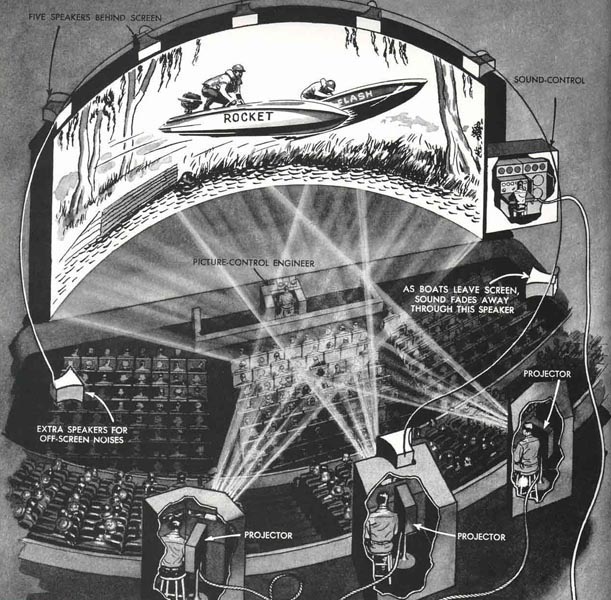
On the trail of building immersive sensory experiences for audiences, Waller invented this three-projector system (3x35mm synchronised projectors), and a curved screen offering 146 degrees of wrap-around viewing. This immersive visual technology was complimented and reinforced by a ” high-quality, seven-track discrete, directional, surround-sound system”. Waller’s search for an immersive audience experience, was trumped some seven years later by a young cine-engineer called Morton Heilig and his Sensorama simulator (1957), though in this case the audience was a single user-participator-viewer-activator.

Abel Gance: Napolean 1927

Abel Gance: Napolean 1927

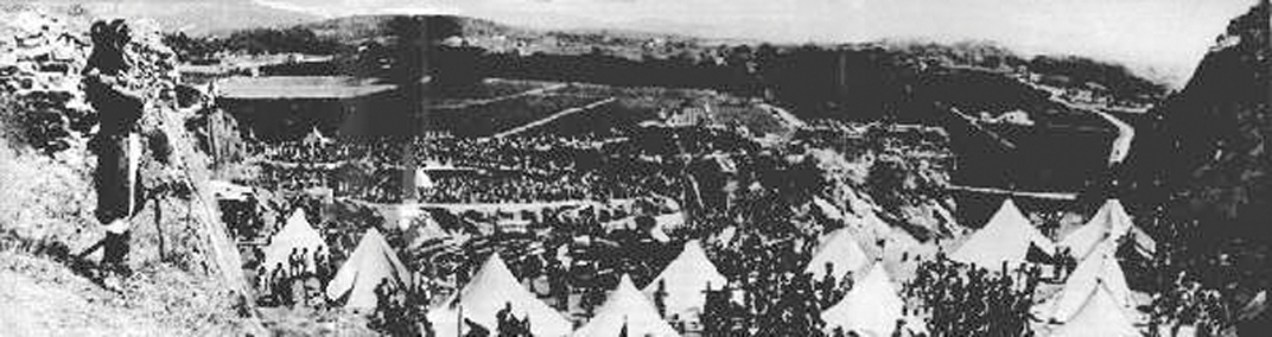
Gance was the genius of innovation in twenties cinema, producing this epic biopic using triple-screen projections, embedded cameras, colour tinting, and much more. Abel Gance was a singular genius of the silent film era, a director who, according to silent film historian Kevin Brownlow “covers every aspect of motion-picture production”. And Napoleon is his masterpiece. It is significant in film and media history: it contains a wealth of innovative camera shots (chest-mounted cameras, saddle-mounted cameras) including big closeups, and three-screen panoramas and montages. And it is most modern in its rapid cutting. According to Brownlow: “Gance wanted to hurl the spectator into the action” – and the scene that exemplifies this is the chase across Corsica where the camera is extremely mobile, intercutting pans and big-closeups as well as tracking shots, to create a tremendously engaging sequence. Apparently Gance did not have the benefit of a Moviola (film-viewer) for editing, and would stick his film clips to a large window in order to edit his tryptich sequences. This is probably the first multi-screen film – creating a fascinating technique for non-linear story-telling that was not to be revisited until the late 1960s (The Thomas Crown Affair (1968), and Woodstock (1970). Eisenstein is said to have thanked Gance for his inspirational cutting technique (Brownlow at http://www.youtube.com/watch?v=GJ2kRzJajyo).

Lazlo Moholy Nagy: Partitura per una eccentrica mecanica 1925

Lazlo Moholy Nagy: Partitura per una eccentrica mecanica 1925

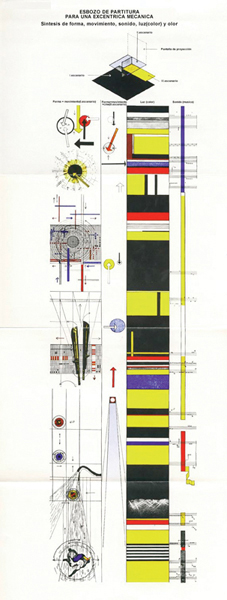
While teaching at the Bauhaus in the 1920s, along with Wassily Kandinsky and Paul Klee, Moholy Nagy developed his ideas for a Theatre of Totality – the Mechanised Eccentric is an attempt to provide a kind of automatic multimedia theatre – dispensing with conventional scripts, with actors, and reducing the performance to basic elements colour, light, sound, shape. The Patritura is a score for this abstract ‘performance’ or stage installation. As such it qualifies Moholy Nagy as one of the prototypical electronic media artists…his Light-Space Modulator of 1932 is another attempt to express and embody this idea of the Theatre of Totality. It also places him as a pioneer of the algorithmic arts – the Partitura is a graphic script – a program.