Richard Dawkins: Biomorphs 1986

Richard Dawkins: Biomorphs 1986

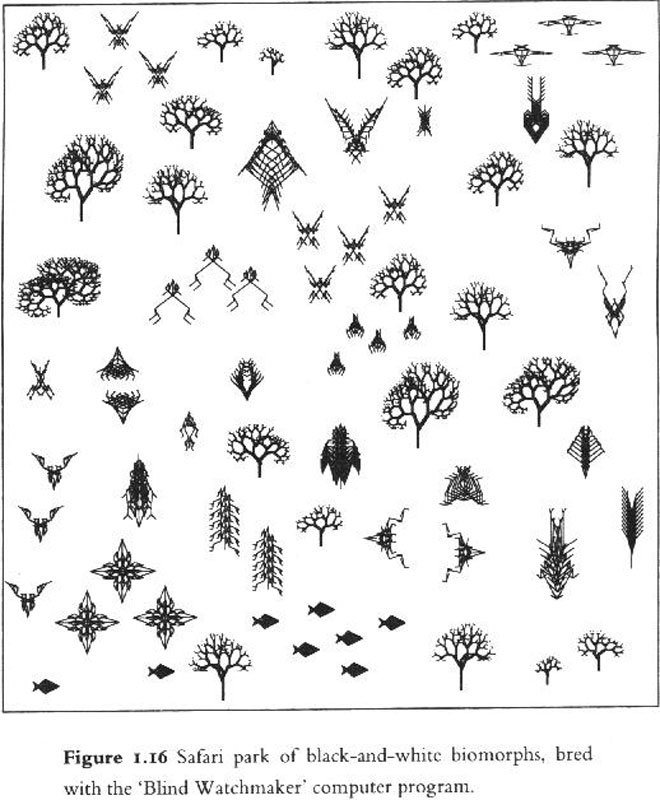
In his 1986 book The Blind Watchmaker, Dawkins described Biomorphs – a simple software program he had written to illustrate the power of Darwinian evolution. His program, written on an Apple Macintosh computer, simulated the evolutionary process of a simple stick-insect-like creature that had merely 9 parameters (or ‘genes’), which could be selected for by the human user. It was an example of un-natural selection, where the selected-for traits were determined by the user thinking – ‘oh that’s interesting!’, or ‘that’s pretty’. The nine gene parameters controlled branching, segmentation and symmetry, and each gene was subject to random mutation. When he ran the program – it drew another iteration of the stick-insect’s evolution every screen-refresh – Dawkins was astonished at the variety such a simple bio-simulator (this research sector became known as Artificial Life and the software a type of  genetic algorithm) could produce.

“When I wrote the program I never thought that it would evolve anything more than a variety of tree-like shapes…Nothing in my biologist’s intuition, nothing in my 20 years’ experience in programming computers, and nothing in my wildest dreams, prepared me for what actually emerged on the screen….(nor) convey my feeling of exaltation as I first watched these exquisite creatures emerging before my eyes.”
From Dawkins: The Blind Watchmaker, 1986.


The moral of this story? That just like in real life, complexity can evolve from some some very simple rules, and genetic variation follows – new ‘species’ emerge.

In his book summing the early years of Artificial Life research, Steven Levy has this to say on the Biomorphs:

“Although the (biomorphs) experiment played like a game, it followed the same rules that nature did. In evolving creatures, Dawkins noted, one was not creating them, but discovering them. They already existed, in a sense, as possible permutations of a given set of genes, and of a finite number of mutations. This was what biologists referred to as ‘genetic space’ a mathematical atlas that geographically located all possible life-forms.”

Steven Levy Artificial Life – The Quest for a New Creation 1992
unknown artist: Diableries 1861

unknown artist: Diableries 1861

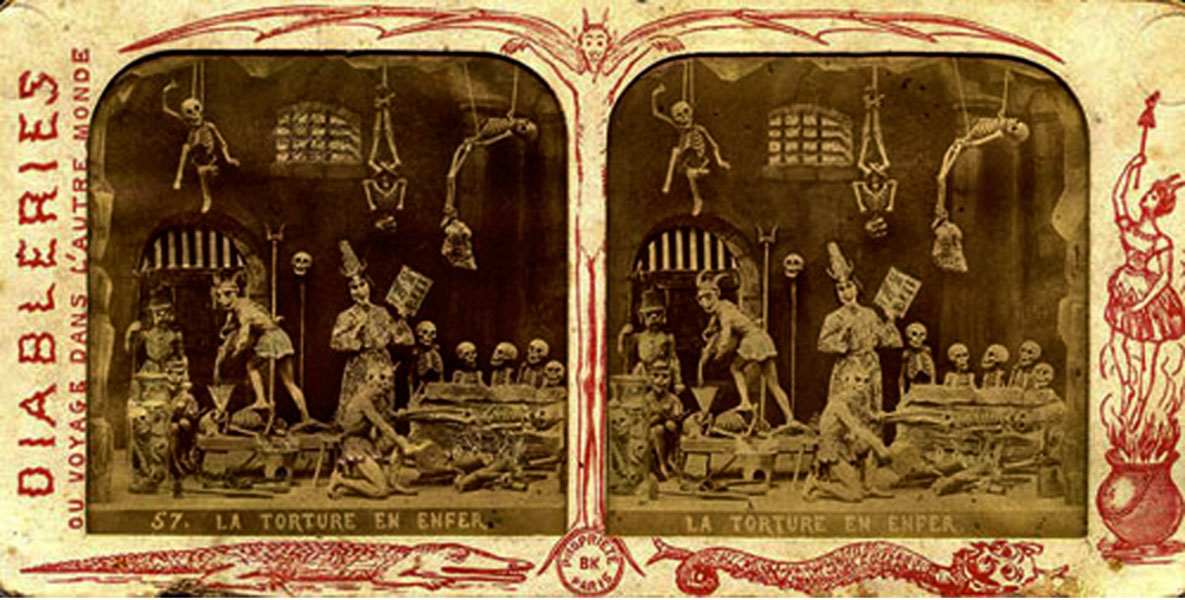
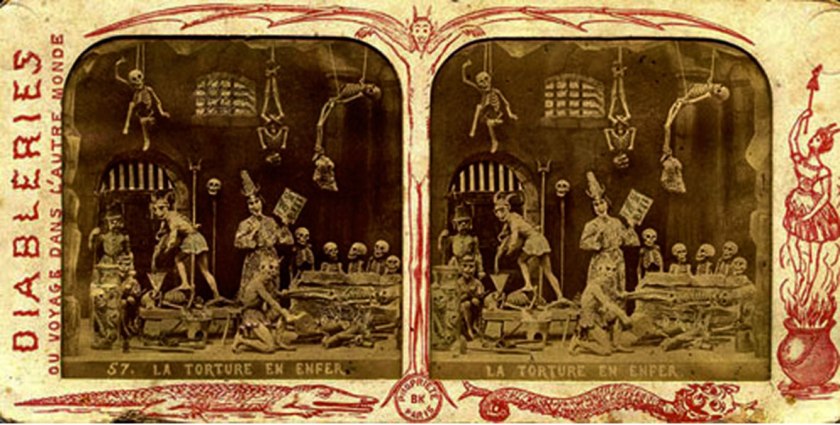
Charles Wheatstone developed his theory of stereopsis in 1838, building a stereoscope to validate his theory. Louis-Jules Duboscq invented the stereograph or stereo photograph in 1851, presenting his new work at the Great Exhibition. In 1852 Duboscq introduced his Duboscq-Soliel Stereo Viewer – a piece of drawing room furniture through which his stereographs could be viewed to obtain the maximum 3-d effect. This machine, and similar stereo viewers engendered an interesting effect – that people, once they had got used to the stereo 3d effect, wanted more images to experience. Hundreds of thousands of stereographs were produced to satisfy this new market for home entertainment, many of them mundane and most of them visually un-inspiring. However from the early 1860s, sets of stereographs began to appear anonymously in Paris and became cult collectibles. Eventually a suite of 72 cards – called Les Diableries – became available and much sought after. The Diableries were photographs of table-top dioramas – tableaux illustrating the machinations of the Devil. Because of the signatures on some of the miniature sculptures and figurines, some surmise that it was the artist Pierre Adolphe Hennetier who was the creator of these fascinating depictions of the underworld. It is interesting that Gaspard-Felix Tournachon (Nadar)’s photographs – the first taken by electric light – in the maze-like Parisian sewers and underground tunnels had been published just a year or so before the Diableries appeared. As if the re-discovery of the real underground Paris catalysed the Diableries as fanciful and macabre visualisations of the metaphysical underground. The Diableries is an extended series of three-dimensional tableaux, tapping into a vein of religious iconography stemming from works like the Danse Macabre of the Mediaeval period, and looking forward to the horror genre of the movies. This is a very accomplished set of stylistically coherent illustrations – a remarkable feat, perhaps even more remarkable for its anonymity. The musician and photo-historian Brian May has collaborated recently on a major study of the Diableries, which is highly recommended.

William Henry Fox Talbot: Photoglyphic Engraving 1858

William Henry Fox Talbot: Photoglyphic Engraving 1858

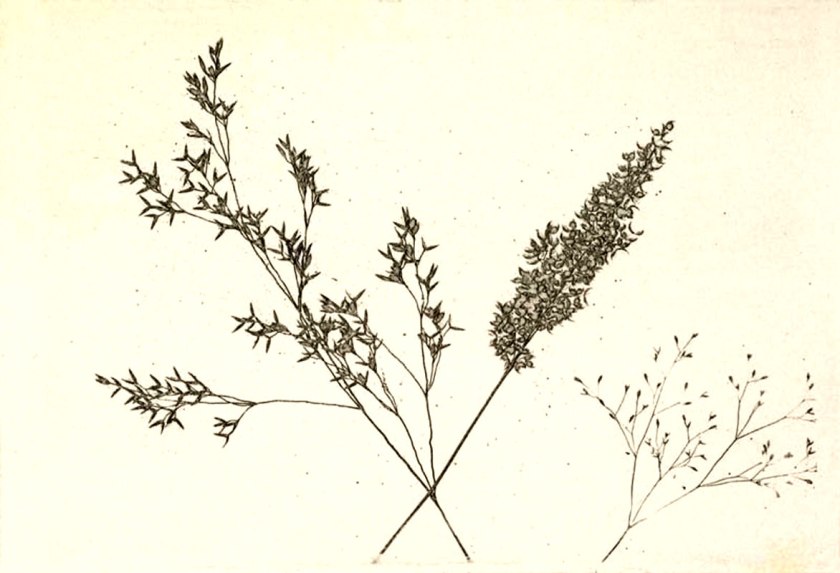
By making images directly onto a photo-sensitised zinc or copper plate, Fox Talbot demonstrates the potential of photo-engraving. The principle was simple. A gelatine and bichromate mixture was coated onto a metal plate, then it is exposed to light through a photo-positive or actual object. Where the light reaches the plate, the gelatine-dichromate mix is hardened, while the image areas can be washed away, thus forming a mask for the etching fluid (acid). When the acid has ‘bitten’ to a suitable depth, the plate is washed, cleaned, then rolled-up with ink. The smooth non-images areas of the plate are wiped free of ink, which remains in the etched image areas, and is then printed in an etching press. The thick blankets of the etching press push the paper into the ink-filled image areas and the print is made. Fox Talbot added a kind of aquatint dusting of gum copal over the image, to create texture for the acid to bite into, and he marvelled at the results – the finest tracery of lines and subtle gradation of tones. Fox Talbot credited the origin of photo glyphic engraving to Wedgwood, who had experimented with these techniques in 1790s. Daguerre’s collaborator, Nicephore Niepce had also experimented (the Physautotype) in the 1820s. Late Karel Klic was to fully develop this technique as the Photogravure process (1878).